Hiring An SEO Services Company In Edinburgh: A Practical Guide
Edinburgh presents a distinctive blend of historic trade, tourism, and growing tech activity, all of which shape how local search users behave. For businesses based in Edinburgh, choosing the right SEO services company is less about chasing abstract rankings and more about aligning with local realities, regulatory expectations, and measurable outcomes. This first part of the guide lays the groundwork for evaluating potential partners, explains why Edinburgh-specific knowledge matters, and outlines the governance and discipline that underpin successful local SEO programmes. You can explore practical resources and service outlines on our Edinburgh Services hub at EdinburghSEO.org and initiate inquiries through the Contact Page to discuss a tailored plan for your business.
Why does local SEO matter in Edinburgh specifically? The city’s geography is tightly linked to consumer behaviour: footfall in the Old Town, the corridors around Princess Street, and the vibrant quarters of Leith and Stockbridge all respond to proximity signals alongside traditional rankings. A local SEO partner familiar with Edinburgh’s search landscape can translate general best practices into district-level content, accurate business data, and optimised maps visibility. By applying a governance framework that justifies every locale decision (CORA Trails) and maintains consistent language choices (Translation Provenance) across updates, Edinburgh campaigns become auditable, scalable, and better aligned with reader expectations.
What to expect From an Edinburgh SEO Partner
An Edinburgh-focused SEO partner should deliver not just technical fixes but a coherent local strategy that respects Edinburgh’s districts, landmarks, and community context. Look for experience across Local Pages (LPs), Canonical Local Pages (CLPs), and Google Business Profile (GBP) surfaces, with a clear plan for auditable localisation and language fidelity. A strong partner will present a staged roadmap, prioritise near‑me actions, and provide dashboards that connect surface health to tangible outcomes such as enquiries, bookings, and revenue by suburb. They should also offer transparent governance artefacts, including CORA Trails and Translation Provenance, to support audits and regulatory reviews as Edinburgh markets evolve.
- Proven local market knowledge, demonstrated by Edinburgh-specific case studies or district-level optimisations.
- Auditable reporting with clear language guidelines and locale rationales for every suburb modifier.
- A phased, low‑risk rollout that scales from a tight hub-and-spoke structure to additional suburbs as evidence accumulates.
- Strong GBP management: cadence, category accuracy, hours, and service areas aligned with LPs and CLPs.
- Ethical link-building and local PR tied to Edinburgh proofs and landmarks to strengthen proximity signals.
To see practical examples of Edinburgh-centred guidance, visit our Edinburgh Services hub and book a scoping discussion through the Contact Page.
A Simple, Structure-First Approach To Edinburgh Local SEO
The most durable Edinburgh campaigns start with a governance-first approach. Establish LPs that anchor local authority and map their relationship to CLPs and GBP signals. Ensure every suburb page surfaces proofs readers recognise, such as local landmarks, transport routes, or community anchors. Translation Provenance helps keep terminology natural across updates, while CORA Trails justify locale modifiers for each suburb so updates remain auditable as you expand through Edinburgh’s districts. This foundation supports rapid, scalable growth without losing topical relevance or auditability.
What This Guide Covers In Part 1
This opening part outlines the principles you’ll encounter throughout the 12-part series. It focuses on establishing the right mindset, locating the right expertise in Edinburgh, and agreeing on governance that travels with growth. You’ll learn how to request a discovery call, what information to prepare, and how to interpret initial proposals so you can compare agencies objectively. The subsequent parts will dive into local signals, keyword strategy, on-page and technical SEO, content and link-building, analytics, budgeting, and practical contract considerations tailored to Edinburgh’s market.
- Why Edinburgh local signals matter: proximity, maps, and district knowledge strengthen near‑me outcomes.
- How governance supports scale: CORA Trails and Translation Provenance create auditable localisation history.
- What to ask when evaluating agencies: governance capabilities, reporting transparency, and Edinburgh-market experience.
- What a typical starter package looks like: a focussed hub-and-spoke setup, GBP hygiene, and a short measurement baseline.
- How to prepare for a discovery call: business objectives, current data, and district priorities.
- Where to find practical resources: the Edinburgh Services hub and the Contact Page for scoping discussions.
Ready to move from theory to action? Start with a no-obligation assessment by booking a discovery through the Contact Page, or explore our Edinburgh Services hub for implementation playbooks and measurement templates. This first part sets the foundation for a route to sustained, locally relevant visibility that grows with Edinburgh’s markets while keeping governance transparent and auditable.
The Value Of Local Edinburgh SEO
Local knowledge matters more than ever for Edinburgh businesses seeking sustainable visibility. A well-executed local Edinburgh SEO programme recognises the city’s unique mix of historic centres, modern business districts, and vibrant neighbourhoods such as the Old Town, New Town, Leith, Stockbridge, and Morningside. By rooting strategy in local realities, you align surface health, user intent, and conversion opportunities with Edinburgh’s distinctive geography and consumer behaviours. This part builds on the governance framework introduced in Part 1 and explains how a local, Edinburgh-first approach translates into practical advantage for an SEO services company in Edinburgh and their clients. Discover practical resources at our Edinburgh Services hub and arrange a scoping discussion through the Contact Page to tailor a district-aware plan for your business.
What makes Edinburgh distinctive for local SEO is how proximity intersects with cultural and logistical cues. Proximity signals extend beyond raw distance to include landmarks (Edinburgh Castle, the Scott Monument), transport arteries (Waverley Station, Princes Street), and community anchors (neighbourhood tenants, local markets, university campuses). An Edinburgh-focused partner translates general best practices into district-level actions: improving GBP presence for specific postcodes, aligning LPs and CLPs to district proofs, and ensuring maps and local citations reflect the real-world geography readers navigate every day. This is not about generic optimisations; it is about auditable localisation that scales with Edinburgh’s evolving markets while staying fully transparent for audits and governance reviews.
What an Edinburgh Partner Delivers
An Edinburgh-centric SEO partner offers more than technical fixes. They provide a governance-driven, locality-aware strategy that connects LPs, CLPs, and GBP with real-world Edinburgh proofs. Expect a phased roadmap starting with a tight hub-and-spoke structure, defined district priorities, and auditable localisation history. A trustworthy partner will present transparent CORA Trails for locale rationales and Translation Provenance to maintain authentic terminology as you scale across Edinburgh’s diverse areas.
- Local market expertise across Edinburgh districts, with district-specific case studies and optimisations.
- Auditable reporting that ties local decisions to district proofs and language guidelines.
- A staged rollout plan that starts small and expands once early signals validate impact.
- Clear governance artefacts, including CORA Trails and Translation Provenance, to support regulatory reviews.
- Ethical, local PR and link-building that reinforce proximity signals without compromising integrity.
A Simple, Structure-First Edinburgh Local SEO
Adopt a governance-first foundation: create Local Pages (LPs) that anchor district authority and map their relationship to Canonical Local Pages (CLPs) and Google Business Profile (GBP) signals. Each suburb page should surface proofs that readers recognise, from landmark references to transport routes. Translation Provenance ensures terminology remains natural across updates, while CORA Trails justify locale modifiers for each Edinburgh district so updates stay auditable as you expand into new areas.
How To Start With Your Discovery
Begin with a practical discovery call to align business objectives with Edinburgh-specific signals. Prepare a district-by-district brief that lists target suburbs, known proofs, and local data points you want to surface. A good disclosure in the brief includes CORA Trails and Translation Provenance expectations so the agency can deliver auditable localisation from day one.
How This Part Connects With Part 1
Where Part 1 established governance, Part 2 translates that governance into local Edinburgh value. You’ll see how district-aware planning, GBP hygiene, and suburb-level localisation unlock practical, measurable outcomes: higher proximity signals, more directions requests, more calls, and more conversions. The Edinburgh Services hub remains your central resource for playbooks, dashboards, and artefacts that codify auditable localisation history as your Edinburgh footprint grows. To begin, book a scoping discussion through the Contact Page or explore our Edinburgh Services hub for district-ready templates and measurement templates that travel with growth.
In summary, the value of local Edinburgh SEO lies in connecting the city’s physical geography to search-visible outcomes. Local knowledge, regular governance, and auditable localisation create a practical pathway from discovery to revenue that scales gracefully across Edinburgh’s districts. For ongoing support, revisit the Edinburgh Services hub and schedule a scoping discussion to tailor a district-focused plan for your business.
What An Edinburgh SEO Company Typically Offers
Edinburgh businesses benefit from a disciplined, locality‑aware approach that combines governance with practical delivery. A typical Edinburgh SEO services company aligns Local Pages (LPs), Canonical Local Pages (CLPs), and Google Business Profile (GBP) signals with real‑world Edinburgh proofs and district content. This part outlines the core services you should expect, the governance artefacts that sustain auditable localisation, and how these elements translate into tangible outcomes for your business. For practical Edinburgh‑specific playbooks and dashboards, visit our Edinburgh Services hub and explore scoping options via the Contact Page.
Core Service Areas You Should Expect
Most Edinburgh campaigns begin with a clearly defined set of service areas designed to surface recognisable proofs for readers. The portfolio typically includes audits and baseline assessments, keyword research mapped to LPs and GBP surfaces, on‑page optimisation, technical SEO, content strategy, and local link building. A credible partner will present a staged roadmap that stays auditable through CORA Trails (locale rationales) and Translation Provenance (authentic terminology) as you scale across Edinburgh’s districts.
- Audits And Baselines: a comprehensive evaluation of technical health, GBP hygiene, and district proofs to establish a trustworthy starting point.
- Keyword Research: a district‑aware keyword universe linking LPs, CLPs, and GBP signals to near‑me opportunities.
- On‑Page Optimisation: optimised title tags, meta descriptions, headers, and internal linking with local relevance.
- Technical SEO: data‑driven improvements to crawlability, site speed, mobile usability, and structured data for local entities.
- Content Strategy And Local PR: district‑proof assets, guides, and credible local media outreach to earn relevant mentions.
- Link Building And Local Citations: trusted, Edinburgh‑focused backlinks and high‑quality local citations that reinforce proximity signals.
Local Governance And Auditability
Edinburgh campaigns benefit from a governance framework that makes localisation decisions reproducible. CORA Trails justify locale modifiers for each suburb, and Translation Provenance keeps terminology natural across content updates. A well‑defined governance cadence ensures every change is reviewable, from LP health updates to GBP post schedules. Regular governance artefacts enable audits and regulator reviews, helping you demonstrate the reliability of Edinburgh‑specific optimisations.
GBP Optimisation And Local Profiles
GBP should be treated as a central, live surface that mirrors LPs and CLPs. Regular updates to categories, hours, and service areas keep proximity signals accurate. Suburb posts should surface proofs readers recognise, such as local landmarks (Edinburgh Castle, Scott Monument), transport routes, and community anchors. Translation Provenance ensures Irish terminology or Scottish linguistic nuances stay natural where applicable, while CORA Trails justify locale modifiers for each Edinburgh suburb so updates remain auditable as you expand.
- Maintain GBP categories that reflect current services and Edinburgh suburbs you actively serve.
- Keep hours and service areas precise and aligned with LPs and CLPs.
- Publish suburb posts that surface reader recognisable proofs and context.
On‑Page Optimisation And Technical SEO
On‑page work includes optimising title tags, meta descriptions, headings, and internal linking with a strong local flavour. Technical SEO covers site speed, mobile usability, crawlability, indexability, structured data, and canonical parity across LPs and CLPs. A robust Edinburgh implementation ensures maps, local knowledge panels, and local business data stay in harmony with user expectations. Translation Provenance preserves authentic Scottish terminology in updates, while CORA Trails justify why each locale modifier remains active as you grow through Edinburgh’s districts.
- Local schema and GBP integration for district proofs.
- NAP consistency across GBP and local pages.
- Mobile‑first, fast loading pages with clear pathways to district proofs.
Content Strategy And Local Digital PR
Edinburgh content should blend local knowledge with sustainable SEO practices. Develop evergreen guides that surface recognisable Edinburgh proofs, district roundups highlighting landmarks and transport corridors, and visuals that aid discovery. Digital PR should target Edinburgh‑centric outlets and local industry publications to earn credible placements. All outreach should be anchored to CORA Trails and Translation Provenance to maintain authentic, auditable language across campaigns.
- District‑proof content assets that feature recognisable Edinburgh landmarks.
- Outreach to Edinburgh outlets for local coverage and credible backlinks.
- Partnerships with Edinburgh organisations to generate authentic mentions.
Measurement, Reporting, And Governance
Measurement should connect surface health to near‑me actions, inquiries, and revenue. Build dashboards that segment by Edinburgh district, LP health, GBP engagement, and conversion outcomes. Governance cadences—weekly tactical reviews, monthly strategic assessments, and quarterly locale revalidations—keep localisation history auditable. CORA Trails and Translation Provenance must be visible in every report to justify locale modifiers and language choices.
To access practical Edinburgh‑specific playbooks and dashboards, visit our Edinburgh Services hub and book a scoping discussion via the Contact Page to tailor the framework to your portfolio. External references, such as Google’s local guidelines, can provide supplementary context, but the real differentiator is auditable localisation history that travels with growth across Edinburgh’s districts.
Targeted Keyword Research For Edinburgh Markets
For Edinburgh businesses, keyword research is the compass that directs content strategy, product positioning, and local outreach. A disciplined approach starts with understanding how readers in Edinburgh search for services, how intent shifts across districts, and how to translate those signals into a scalable keyword universe. By anchoring research to Local Pages (LPs), Canonical Local Pages (CLPs), and Google Business Profile (GBP) surfaces, you create an auditable foundation that scales with the city’s districts such as the Old Town, New Town, Leith, Stockbridge, Morningside, and beyond. CORA Trails justifies locale modifiers for each suburb, and Translation Provenance preserves authentic Edinburgh terminology throughout updates.
Understanding Local Search Intent In Edinburgh
Local search in Edinburgh blends proximity with relevance. Readers search for near-me services, suburb-specific specialists, and location-aware guidance. Segment intent into informational queries about neighbourhoods, transactional prompts like book or call actions, and navigational needs such as directions or opening hours. Align these intents with the Edinburgh suburb network so LPs surface proofs readers recognise, from the Old Town landmarks to transport corridors around Waverley Station. Translation Provenance ensures terminology stays natural across updates, while CORA Trails justify locale modifiers for each suburb so updates remain auditable as you grow.
Structuring Edinburgh Keyword Portfolios
Construct a city-wide keyword portfolio with a clear spine and suburb spokes. Begin with core Edinburgh terms that describe your service area, then expand into long-tail variants that combine service intent with suburb modifiers. For example, pairs like "Edinburgh web design" and "Edinburgh web design Leith" extend reach while preserving locality. Use CORA Trails to justify locale modifiers for each suburb and Translation Provenance to keep terminology consistent. Prioritise keywords that map to near-me actions, GBP engagement, and LP health signals so they feed auditable dashboards from day one.
- Core Edinburgh keywords: base terms that represent your main offerings in the city, such as "Edinburgh web design" or "local SEO Edinburgh".
- Long-tail variants by suburb: phrases combining services with district names like "Edinburgh SEO Leith" or "Edinburgh PPC New Town".
- Intent-driven groupings: informational, navigational, and transactional keywords that align with LP and GBP cadences.
- Geo-competitiveness assessment: estimate difficulty and potential impact for each suburb to prioritise waves of content and outreach.
- Language fidelity: apply Translation Provenance to preserve authentic Edinburgh terminology where applicable and ensure consistent phrasing across updates.
As you build the portfolio, remember the goal is an auditable trail showing why each suburb modifier exists and how it supports near-me actions. This enables governance reviews and demonstrates ROI to stakeholders, while keeping the Edinburgh network coherent and scalable.
Prioritising Keywords For Edinburgh Markets
Prioritisation should balance potential impact with effort. Focus on keywords that drive near-me actions and high-intent visits, then layer in suburb-focused proofs to strengthen GBP and map presence. A practical approach is to score each term on three axes: relevance to your primary services, proximity to a Edinburgh suburb where you operate, and expected conversion potential from GBP and LP surfaces. CORA Trails justify locale modifiers for each suburb, while Translation Provenance ensures language fidelity across updates.
- High-intent transactional terms: examples include "best Edinburgh web design agency".
- Suburb-specific variants: unlock near-me queries and maps visibility, e.g., "Edinburgh SEO Leith" or "Edinburgh PPC Stockbridge".
- Informational content ideas: seed authority and long-tail capture, e.g., "how to choose an Edinburgh SEO agency".
Practical Tools And Playbooks
Leverage familiar tools to populate and test your Edinburgh keyword universe. Start with Google Keyword Planner for volume data, then use Ahrefs or SEMrush for competitive insights and keyword difficulty by suburb. Build a local intent matrix that pairs service queries with suburb modifiers, and use Translation Provenance to standardise terminology across Scotland-wide and Edinburgh-specific contexts. CORA Trails will justify locale modifiers for each suburb as you expand, ensuring auditable decisions remain traceable.
- Core tools: Google Keyword Planner, Ahrefs, SEMrush for volume, difficulty, and competitive insights.
- Intent matrix: map service queries to suburb modifiers to surface near-me actions in GBP and LPs.
- Language fidelity: apply Translation Provenance to keep Edinburgh terminology natural across updates.
- Audit-ready templates: CORA Trails documentation and language guidelines embedded in briefs.
For practical templates, playbooks, and dashboards that codify auditable localisation history, visit our Edinburgh Services hub and book a scoping discussion via the Contact Page to tailor a keyword research plan for your Edinburgh portfolio. External benchmarks from Google Local Guidelines can provide supplementary context, but the differentiator remains auditable localisation history that travels with growth across Edinburgh's districts.
Read next: SEO services in Edinburgh: what you get · Edinburgh SEO services for local firms
On Page Optimisation And Technical SEO In Edinburgh
Edinburgh campaigns demand a disciplined blend of on‑page optimisation and robust technical foundations, all aligned to Local Pages (LPs), Canonical Local Pages (CLPs), and Google Business Profile (GBP) signals. In practice, this means every Edinburgh suburb you serve should have optimised title tags, meta descriptions, headers, and internal links that surface recognisable proofs readers expect—landmarks, transport routes, and community anchors identified in CORA Trails. Translation Provenance ensures terminology remains authentic across updates, so language fidelity travels with growth while audits remain straightforward for governance reviews.
Core On‑Page Elements For Edinburgh
- Title tags and meta descriptions: craft location‑specific titles that include Edinburgh suburbs (for example, "Edinburgh SEO Leith"), and write meta descriptions that emphasise proximity, proofs, and action triggers like directions or enquiries.
- Headers and content structure: use H1/H2 hierarchies that mirror district priorities, ensuring each suburb page surfaces district proofs readers recognise.
- Internal linking strategy: create logical pathways between LPs, CLPs, and GBP posts to guide readers through the Edinburgh suburb network and reinforce canonical parity.
- Local schema and structured data: implement LocalBusiness, Organization, and FAQ schemas tied to GPB and LP content to improve rich results in Edinburgh queries.
- NAP consistency across surfaces: align name, address, and phone numbers across LPs, CLPs, and GBP to strengthen proximity signals.
Technical Health Essentials For Local Edinburg
Beyond on‑page cues, technical SEO underpins reliability and speed, which in turn influence user experiences and rankings. Edinburgh campaigns benefit from a mobile‑first approach, optimised image handling for local visuals, and rigorous crawlability controls so search engines can index suburb proofs without friction. Structured data should be extended to support district proofs, events, and local services, all keeping Translation Provenance intact so terminology remains natural as the Edinburgh footprint expands.
- Site speed optimisations: prioritise critical rendering paths, minify assets, and leverage caching to maintain fast Edinburgh page loads.
- Mobile usability: ensure touch targets are accessible and layout adapts gracefully across Edinburgh’s device mix.
- Crawlability and indexability: provide clear robot directives, clean navigation, and suburb‑level sitemaps so search engines discover proofs quickly.
- Structured data depth: expand LocalBusiness, Service, and FAQ schemas to reflect district proofs readers expect in Leith, Stockbridge, or New Town.
GPS, GBP Hygiene, And Local Proximity Signals
GBP hygiene remains a critical lever for Edinburgh. Regularly refresh categories, hours, and service areas to maintain accurate proximity signals. Suburb posts should surface recognisable proofs and context readers can verify quickly, and Translation Provenance should guide the language used across GBP updates to reflect local nuances. A disciplined cadence ensures GBP surfaces stay driven by real district activity, not generic optimisations.
- GBP category alignment to reflect active Edinburgh services and suburbs.
- Precise hours and service areas that mirror LPs and CLPs.
- Suburb posts with recognisable proofs such as landmarks and transport corridors.
Governance, Audits, And Localisation History
Auditable localisation is not optional; it is the backbone of governance for Edinburgh campaigns. CORA Trails justify every locale modifier for each suburb, while Translation Provenance preserves authentic Edinburgh terminology across updates. Maintain change logs for page rotations, schema adjustments, and GBP post schedules so auditors can replay decisions with confidence. A clear governance cadence—weekly tactical reviews, monthly strategic checks, and quarterly locale revalidations—ensures the Edinburgh network grows without losing topical relevance or auditability.
Practical Steps To Start On Page Optimisation Today
1) Audit each core Edinburgh suburb page to verify the alignment of LPs, CLPs, and GBP elements with locale proofs. 2) Implement a suburb‑level content spine that surfaces recognisable proofs for readers, supported by Translation Provenance. 3) Deploy local schema extensions and ensure NAP parity across all Edinburgh surfaces. 4) Establish a governance log that records locale rationales behind every modifier and every update. 5) Connect your dashboards to the Edinburgh Services hub for templates, dashboards, and CORA Trails documentation to support regulator reviews and audits.
For ongoing guidance, explore our Edinburgh Services hub for practical templates and measurement dashboards, and book a scoping discussion through the Contact Page to tailor a local on‑page and technical SEO plan that travels with growth across Edinburgh. Anchoring every decision in CORA Trails and Translation Provenance not only strengthens trust but also simplifies governance as your Edinburgh footprint expands.
On Page Optimisation And Technical SEO In Edinburgh
Edinburgh campaigns demand a disciplined pairing of on‑page optimisation with robust technical foundations, all aligned to Local Pages (LPs), Canonical Local Pages (CLPs), and Google Business Profile (GBP) signals. In practice, this means each Edinburgh suburb you serve should have optimised title tags, meta descriptions, headers, and internal links that surface recognisable proofs readers expect — landmarks, transport routes, and community anchors identified in CORA Trails. Translation Provenance ensures terminology remains authentic across updates, so language fidelity travels with growth while audits stay straightforward for governance reviews.
Core On‑Page Elements For Edinburgh
- Title tags and meta descriptions: craft location‑specific titles that include Edinburgh suburbs (for example, "Edinburgh SEO Leith"), and write meta descriptions that emphasise proximity, proofs, and clear action prompts such as directions or enquiries.
- Headers and content structure: use a logical H1/H2/H3 hierarchy that mirrors district priorities, ensuring each suburb page surfaces proofs readers recognise.
- Internal linking strategy: establish purposeful pathways between LPs, CLPs, and GBP posts to guide readers through Edinburgh’s suburb network and reinforce canonical parity.
- Local schema and structured data: implement LocalBusiness, Organization, and FAQ schemas tied to GBP and LP content to improve rich results for Edinburgh queries.
- NAP consistency across surfaces: align name, address, and phone numbers across LPs, CLPs, and GBP to strengthen proximity signals.
Technical Health Essentials For Local Edinburgh
- Site speed optimisations: prioritise critical rendering paths, minify assets, and leverage caching to maintain fast Edinburgh page loads, especially for district landing pages.
- Mobile usability: ensure mobile‑first design with accessible navigation, touch targets, and legible typography for readers on the move around the city.
- Crawlability and indexability: supply clear robot directives, clean navigation, and suburb‑level sitemaps so search engines discover proofs quickly without getting lost in the site hierarchy.
- Structured data depth: extend LocalBusiness, Service, and FAQ schemas to reflect district proofs readers expect in Leith, Stockbridge, New Town, and beyond.
Suburb‑Level Proofs And Content Strategy
District proofs act as the tangible anchors readers recognise when they search for services in Edinburgh. Build a tidy content spine that surfaces recognisable proofs — landmarks, transit routes, universities, and local events — while maintaining Translation Provenance to ensure terminology remains natural as you grow. CORA Trails justify locale modifiers for each suburb, keeping updates auditable as new areas are added.
GBP Integration And Local Profiles
GBP should be treated as a central, live surface that mirrors LPs and CLPs. Regular updates to categories, hours, and service areas keep proximity signals accurate. Suburb posts should surface proofs readers recognise, such as Edinburgh landmarks or transport corridors, with Translation Provenance guiding language across GBP updates. A disciplined cadence ensures GBP surfaces stay aligned with real district activity rather than generic optimisations.
- GBP categories: reflect active Edinburgh services and suburbs you actively serve.
- Hours and service areas: precise, aligned with LPs and CLPs.
- suburb posts with proofs: surface recognisable context readers can verify.
Governance And Auditing For Edinburgh SEO
Auditable localisation is not optional; it underpins governance for Edinburgh campaigns. CORA Trails justify locale modifiers for each suburb, while Translation Provenance preserves authentic Edinburgh terminology across updates. Maintain change logs for page rotations, schema adjustments, and GBP post schedules so audits can replay decisions with confidence. A regular governance cadence — weekly tactical reviews, monthly strategic assessments, and quarterly locale revalidations — keeps Edinburgh’s network current and auditable.
To access practical Edinburgh‑specific playbooks, dashboards, and governance artefacts, visit our Edinburgh Services hub and book a scoping discussion via the Contact Page to tailor the governance framework to your portfolio. The end goal is auditable localisation that travels with growth across Edinburgh’s districts while staying regulator‑friendly.
If you’re starting out, a practical next step is a discovery call to align your business objectives with Edinburgh‑specific signals. Prepare a district‑by‑district brief that lists target suburbs, known proofs, and local data points to surface. A clear CORA Trails and Translation Provenance expectation will help agencies deliver auditable localisation from day one.
For ongoing resources, explore our Edinburgh Services hub for implementation playbooks and measurement templates, and book a scoping discussion through the Contact Page to tailor a suburb‑focused on‑page and technical SEO plan that travels with growth across Edinburgh.
How To Choose And Start With An Edinburgh SEO Partner
Selecting the right seo services company in Edinburgh is a decision that shapes not just rankings but governance, trust, and long-term growth. A local partner should bring Edinburgh-specific fluency, transparent processes, and a clear path from discovery to revenue. This part offers a practical, checklist-driven approach to evaluating agencies, requesting credible scoping, and starting a project that remains auditable as your Edinburgh footprint expands. For practical Edinburgh-specific playbooks and dashboards, explore our Edinburgh Services hub and initiate a scoping discussion via the Contact Page to tailor a district-aware plan for your business.
Why does this choice matter locally? Edinburgh’s mix of historic centres and growing suburbs creates distinct search behaviour and consumer expectations by district. A partner with proven Edinburgh experience translates generic best practices into district-aware strategies, ensuring Local Pages (LPs), Canonical Local Pages (CLPs), and Google Business Profile (GBP) surfaces align with reader intent and proximity signals. The aim is auditable localisation that scales with governance artefacts such as CORA Trails and Translation Provenance, maintaining clarity and accountability across updates and audits.
Step 1: Define Your Local Objectives And Success Metrics
Begin with outcome-focused objectives that tie to near-term actions and longer-term growth. Typical targets include increased directions requests, more phone enquiries, higher footfall in Edinburgh locations, and measurable improvements in GBP visibility by district. Define success metrics for each priority suburb, and ensure data sources and attribution are agreed in advance so proposals are comparable on a like-for-like basis.
- Clear localisation goals by district (Old Town, Leith, Stockbridge, New Town, etc.).
- Defined near-me actions linked to LPs and GBP signals.
- Baseline dashboards that map health, engagement, and revenue by suburb.
Step 2: Build A District-Aware Discovery Brief
Prepare a discovery brief that outlines target suburbs, known proofs to surface (landmarks, transport routes, university campuses, markets), and preferred data points. Include expectations for CORA Trails (locale rationales) and Translation Provenance (authentic Edinburgh terminology). A well-structured brief helps agencies deliver a scoping plan that is auditable from day one and mirrors the governance model you want to sustain.
- List four to six primary Edinburgh districts to prioritise.
- Specify district proofs readers should recognise in content and pages.
- Identify data sources you want surfaced in LPs and GBP posts.
Step 3: Request Credible Proposals And Case Studies
Ask for Edinburgh-focused case studies, district-level roadmaps, and auditable governance artefacts. Look for explicit demonstrations of CORA Trails and Translation Provenance in previous work, plus dashboards that break out performance by suburb. A transparent proposal should show how near-me actions are connected to GBP and LP health, with a staged rollout plan that scales safely as you expand to more Edinburgh districts.
- Suburb-specific prior results and district proofs.
- Governance artefacts that back localisation decisions.
- Proposed roadmap, milestones, and risk mitigation for the Edinburgh market.
Step 4: Arrange A No-Obligation Discovery Call Or Audit
Use a discovery call to test cultural fit, governance maturity, and practical capabilities. Request a diagnostic audit as a baseline, so you can compare agencies against a concrete starting point. Prioritise partners who can demonstrate auditable localisation, with CORA Trails showing the rationale for locale modifiers and Translation Provenance ensuring language fidelity across Edinburgh content and GBP updates.
- Access to an initial audit showing LP health, GBP hygiene, and district proof readiness.
- Demonstrated plans for data governance, including change logs and dashboards.
- Clarity on pricing, milestones, and reporting cadence.
Step 5: Confirm Contracting And Governance Cadence
Your contract should articulate clear deliverables, reporting frequency, and an auditable governance cadence. Seek explicit SLAs for data freshness, GBP updates, and LP health monitoring. Governance artefacts — CORA Trails and Translation Provenance — must be embedded in the working documents and dashboards so every locale decision is replayable for audits and regulator reviews. Build in a quarterly locale revalidation as you expand through Edinburgh’s districts, ensuring language fidelity remains intact across updates.
- Defined scope, milestones, and exit clauses.
- Regular reporting cadence with district dashboards.
- Visibility of CORA Trails and Translation Provenance in every update.
To explore practical templates, dashboards, and governance artefacts for Edinburgh, visit our Edinburgh Services hub, and book a scoping discussion via the Contact Page to tailor a district-ready plan for your portfolio. For reference points, Google’s local guidelines offer useful context, but the differentiator is auditable localisation history that travels with growth across Edinburgh’s districts.
Preparing thoughtfully before engaging accelerates momentum. Compile a short, district-by-district brief, gather access to your analytics and GBP accounts where possible, and identify the four to six suburbs you’ll pilot first. This foundation helps you compare agencies on real, practice-ready criteria rather than abstract promises.
Link Building And Domain Authority In Edinburgh SEO
Edinburgh businesses rely on a disciplined, locality-aware approach to backlinks and domain authority. This part explains how to earn high quality, relevant links and maintain a healthy backlink profile that supports Local Pages (LPs), Canonical Local Pages (CLPs), and Google Business Profile (GBP) signals. Our Edinburgh Services hub provides templates and dashboards to support auditable localisation as you grow across Edinburgh's districts. Visit our Edinburgh Services hub and arrange a scoping discussion via the Contact Page to tailor a district-focused outreach plan.
Key principles for Edinburgh link building include prioritising relevance and proximity, emphasising quality over volume, and integrating digital PR with localisation governance. CORA Trails justify locale modifiers for each suburb and Translation Provenance keeps terminology authentic as content updates roll out. A regulator-friendly approach means you can replay outreach decisions and demonstrate causal links from backlinks to local actions.
- Prioritise Edinburgh-focused sources: local universities, business networks, media outlets, and chamber of commerce listings.
- Quality over quantity: seek links from authoritative Edinburgh domains with meaningful relevance rather than mass directory placements.
- Integrate Digital PR with LP and GBP signals to strengthen proximity and trust.
- Maintain NAP consistency and local citations across Edinburgh surfaces to reinforce proximity signals.
- Document locale rationales and language choices in CORA Trails and Translation Provenance for auditable governance.
Ethical Outreach And Edinburgh Specificity
Outreach should be grounded in real value for Edinburgh readers. Craft district-aware story angles, publish data-backed local assets, and secure placements on credible Edinburgh-focused platforms. Link prospects must be relevant to the suburb network and content spine, ensuring that every earned link supports surface health and user intent across LPs, CLPs, and GBP. Translation Provenance ensures language remains faithful to Edinburgh terminology while CORA Trails justify why each suburb modifier is necessary as you expand.
- Develop district-centric assets that attract natural backlinks from Edinburgh publishers and institutions.
- Conduct personalised outreach that references Edinburgh proofs readers recognise, such as landmarks and transport corridors.
- Include clear attribution and disclosure for content collaborations in line with local governance expectations.
Measurement, Governance, And Link Quality
Track link velocity, referring domains, and the quality of Edinburgh backlinks against LP health, CLP depth, and GBP engagement by district. Build auditable dashboards that show how backlinks translate into near-me actions and conversions. Keep CORA Trails visible in reports to justify locale modifiers and Translation Provenance to preserve language fidelity across updates. Governance cadences should include weekly tactical reviews and monthly governance checks to prevent drift and maintain a credible link network across Edinburgh.
- Monitor backlink quality by domain authority, relevance to Edinburgh topics, and domain trust signals.
- Align link-building with GBP and LP health to amplify proximity signals.
- Maintain a transparent log of outreach activities, placements, and follow-up actions for audits.
Templates, Playbooks And Getting Started
Access templates, data dictionaries, and outreach playbooks via our Edinburgh Services hub. Prepare a scoping brief that lists target suburbs, proofs to surface, and local data points you want to surface. Then book a scoping discussion via the Contact Page to tailor a district-focused outreach plan. For additional context, Google Local Guidelines offer useful guardrails, but your auditable localisation history is the real differentiator as Edinburgh expands.
Start small with a district spine and a handful of high-potential suburbs, then scale based on measured impact. Maintain governance artefacts, CORA Trails and Translation Provenance, to ensure every link decision is reproducible and auditable for regulators and stakeholders. Revisit the Edinburgh Services hub and book a scoping discussion to tailor a long-term link-building programme that grows with your Edinburgh footprint.
Local SEO Essentials For Edinburgh: Citations, GBP, Reviews, And Map Pack Rankings
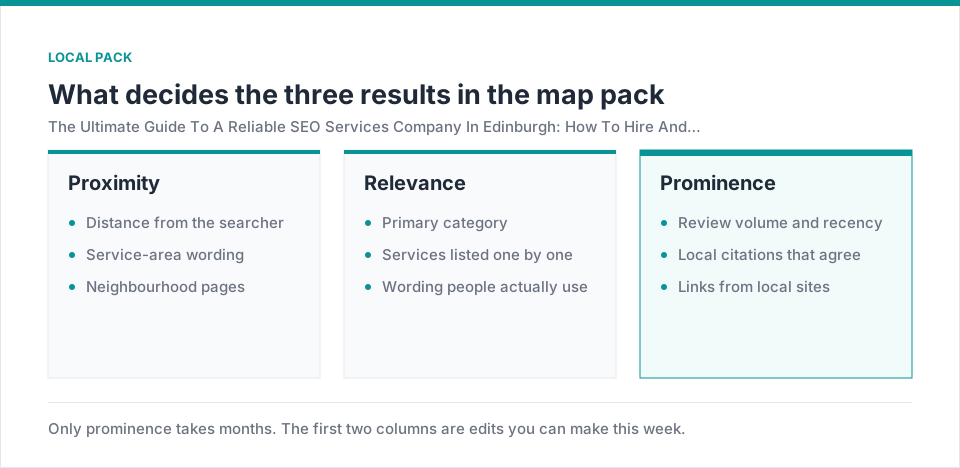
For Edinburgh businesses aiming to strengthen local visibility, a disciplined approach to local SEO is essential. Local citations, a well-optimised Google Business Profile (GBP), authentic customer reviews, and robust map pack positioning together form the core signals that help nearby customers discover you. This part focuses on practical, Edinburgh–specific practices you can implement through our Edinburgh Services hub at our Edinburgh Services hub and by initiating a scoping discussion via the Contact Page. The aim is to create a credible, auditable ecosystem where proximity signals translate into real-world outcomes while keeping governance transparent.
Consistency across local data and appearances is more than a hygiene task; it is a performance lever. In Edinburgh, readers expect district-specific proofs such as the Old Town’s historic streets, Leith’s harbour ambience, or Stockbridge’s boutique clusters. By aligning citations, GBP stakes, and review platforms with these recognisable proofs, you improve proximity signals, credibility, and the likelihood of being surfaced in relevant local queries.
Consistent Local Citations And NAP
Local citations reinforce the city’s proximity footprint. Ensure name, address, and phone numbers (NAP) are exactly consistent across all Edinburgh surfaces, including LPs, CLPs, GBP, and key local directories. Use CORA Trails to document locale rationales behind each suburb modifier and Translation Provenance to preserve authentic Edinburgh terminology when listing services and locations. A disciplined approach keeps citation data auditable and reduces the risk of conflicting information that could confuse readers or search engines.
- Audit major Edinburgh directories for NAP consistency and category relevance.
- Prioritise high-authority, Edinburgh-focused domains that reflect your service area.
- Regularly refresh citations when you launch new districts or services.
Google Business Profile Optimisation
GBP is a live surface that should mirror your Edinburgh footprint. Keep categories accurate, hours current, and service areas aligned with LPs and CLPs. For suburb pages, surface proofs readers recognise, such as local landmarks, transport arteries, and community anchors, within GBP posts where appropriate. Translation Provenance preserves authentic terms for Scottish dialects and Edinburgh references, while CORA Trails justify locale modifiers for each suburb so updates remain auditable as you grow.
- Consistent GBP categories that reflect the services you actively provide in Edinburgh.
- Regular updates to hours and service areas to match LPs and CLPs.
- Suburb-focused GBP posts that surface recognisable proofs to readers, such as landmarks and transport links.
Reviews, Ratings, And Customer Feedback
Reviews are not just social proof; they influence GBP signals and consumer trust. Implement a systematic review management process that responds promptly and authentically in language appropriate to Edinburgh readers. Track sentiment shifts by district and surface common proofs readers reference in feedback. Translation Provenance ensures language remains natural, while CORA Trails justify locale decisions for which service areas and proofs are highlighted in responses.
- Encourage reviews from customers who interacted in Edinburgh districts such as Old Town, New Town, Leith and Stockbridge.
- Respond to reviews promptly with factual updates where appropriate, avoiding generic scripts.
- Highlight district proofs in responses to reinforce relevance and trust.
Map Pack And Local Knowledge Panels
Map pack visibility depends on accurate business data, consistent NAP, and well-structured local content. Ensure LPs surface district proofs readers recognise, and that knowledge panels reflect your Edinburgh presence with up-to-date categories and services. Local signalling benefits from Translation Provenance, maintaining authentic Edinburgh terminology across updates, and CORA Trails that justify the need for every locale modifier as you expand into new suburbs.
- Align LPs, CLPs, and GBP with precise local data and proofs for each Edinburgh district.
- Utilise schema enhancements to surface local information in a way readers recognise.
- Coordinate GBP posts with suburb content to boost proximity and engagement.
For practical Edinburgh-specific playbooks, dashboards, and governance artefacts, revisit our Edinburgh Services hub and book a scoping discussion via the Contact Page to tailor a local, auditable approach. External references such as Google Local Guidelines provide helpful guardrails, but the real differentiator is auditable localisation history that travels with growth across Edinburgh’s districts.
How To Choose And Start With An Edinburgh SEO Partner
Selecting the right seo services company in edinburgh is a decision that shapes governance, trust, and sustainable growth for your local business. A partner with deep Edinburgh fluency translates general best practices into district-aware strategies, auditable localisation, and a transparent working rhythm. This part provides a practical, district-focused checklist to evaluate agencies, request credible scoping, and begin a project that remains auditable as your Edinburgh footprint expands. For practical Edinburgh-specific playbooks and dashboards, explore our Edinburgh Services hub and book a scoping discussion through the Contact Page to tailor a district-ready plan for your portfolio.
Step 1: Define Your Local Objectives And Success Metrics
Start with clearly stated objectives that map directly to Edinburgh’s districts. Tie proximity signals, GBP engagement, and suburb health to near‑me actions and revenue outcomes. Establish district targets (Old Town, Leith, Stockbridge, New Town, and beyond) and assign owners for each suburb. Create baseline dashboards that track surface health, engagement, and conversions by district, ensuring every target can be audited against CORA Trails and Translation Provenance.
- Local outcome goals by district, with measurable lead indicators such as directions requests and telephone inquiries.
- Defined ownership and accountability for LPs, CLPs, and GBP signals per Edinburgh area.
- Baseline dashboards that connect surface health to revenue by suburb.
Step 2: Build A District‑Focused Discovery Brief
Prepare a discovery brief that articulates target suburbs, recognised proofs readers should surface, and the data surfaces you want to prioritise. Include CORA Trails and Translation Provenance expectations to ensure locale rationales and authentic Edinburgh terminology travel from day one. A well-structured brief helps potential partners craft scoping plans that are auditable, repeatable, and scalable as you expand through the city’s districts.
- List four to six Edinburgh districts to prioritise, with rationale for each.
- Specify district proofs to surface in LPs and GBP posts (landmarks, transport routes, events).
- Identify data surfaces and attribution paths to demonstrate ROI by suburb.
Step 3: Request Edinburgh-Focused Case Studies And Governance Artefacts
A credible proposal should include Edinburgh-case studies, district roadmaps, and governance artefacts. Look for explicit demonstrations of CORA Trails (locale rationales) and Translation Provenance (authentic Edinburgh terminology) in prior work. Require dashboards that break down performance by district and near‑me actions linked to GBP engagement, LP health, and CLP depth. A well‑structured proposal also outlines a staged rollout plan with risk mitigation tailored to Edinburgh’s market.
- Suburb-level results and district proofs from similar Edinburgh implementations.
- Governance artefacts, including CORA Trails and Translation Provenance, demonstrated in previous engagements.
- Proposed phased roadmap with milestones, success criteria, and clear dependencies.
Step 4: Arrange A No-Obligation Discovery Call Or Audit
Use an introductory call to test cultural fit, governance maturity, and practical capabilities. Request a diagnostic audit as a baseline so you can compare agencies against a concrete starting point. Emphasise auditable localisation via CORA Trails and Translation Provenance, and seek clarity on how they will surface Edinburgh district proofs and maintain language fidelity throughout updates.
- Access to an initial LP/GBP health audit and district readiness assessment.
- Clear plans for data governance, change logs, dashboards, and review cadences.
- Transparent pricing, milestones, and reporting expectations.
Step 5: Compare Proposals On Governance Cadence And Localisation Maturity
When reviewing proposals, prioritise governance maturity, auditable workflows, and Edinburgh-specific familiarity. Look for explicit CORA Trails that justify locale modifiers, Translation Provenance that preserves authentic terminology, and dashboards that are ready to surface district health, GBP engagement, and near‑me actions. Ensure the agency demonstrates a practical plan for a hub‑and‑spoke structure within Edinburgh’s districts and a realistic path to scaling while maintaining language fidelity.
- Evidence of district-focused case studies and measurable district outcomes.
- Clearly defined governance cadences (weekly tacticals, monthly strategic reviews, quarterly revalidations).
- Proven relocation of proofs and localisation as you expand to new Edinburgh suburbs.
Step 6: Start With A Pragmatic 90‑Day Pilot
Agree a compact pilot that centres on GBP hygiene, a small hub of Local Pages, and the spine of district proofs. Monitor LP health, GBP cadence, and near‑me actions by suburb, using CORA Trails to justify locale modifiers and Translation Provenance to maintain language fidelity. The pilot should yield a tangible baseline for near‑term revenue impact and provide a framework for governance documentation that travels with growth.
- Phase 1: GBP hygiene, 2–3 suburb LPs, and essential district proofs.
- Phase 2: Expand to additional Edinburgh suburbs based on pilot results.
- Phase 3: Refine attribution rules and governance cadence for scalable growth.
Throughout the pilot, maintain auditable localisation by documenting locale rationales in CORA Trails and language choices in Translation Provenance. This discipline makes governance reviews straightforward and supports regulator readiness as Edinburgh campaigns expand.
Onboarding And Team Integration
Prepare your internal teams for a smooth transition by sharing the district-focused brief, governance artefacts, and dashboards. Assign a single point of contact for each Edinburgh district and ensure they have access to the Edinburgh Services hub for templates and playbooks. Establish regular touchpoints with your chosen partner to review progress, align on near‑me actions, and adjust the district-spoke content spine as needed. Internal alignment is essential to ensure your local SEO programme travels with the same governance terms used in outreach, content, and GBP management.
To keep momentum, revisit our Edinburgh Services hub for updated playbooks and dashboards, and schedule a scoping discussion via the Contact Page to tailor the partner engagement plan for your Edinburgh portfolio. A disciplined approach, grounded in CORA Trails and Translation Provenance, will deliver auditable localisation and measurable growth across Edinburgh’s districts.
Want the numbers behind this? The analytics guide shows how organic traffic and the queries GA4 hides are rebuilt in Semalt.
How To Choose And Start With An Edinburgh SEO Partner
Selecting the right SEO services company in Edinburgh is more than chasing higher rankings. It is about governance, transparency, and a partnership that scales with your business across Edinburgh’s districts from the Old Town to Leith and beyond. This part provides a practical, district-aware checklist to evaluate agencies, request credible scoping, and begin a programme that remains auditable as your Edinburgh footprint expands. For practical Edinburgh-specific playbooks and dashboards, explore our Edinburgh Services hub and arrange a scoping discussion through the Contact Page to tailor a district-focused plan for your portfolio.
Step 1: Define Your Local Objectives And Success Metrics
Begin with outcomes that reflect Edinburgh’s distinctive geography and consumer behaviour. Local objectives should translate into near‑term actions and longer‑term growth, with district targets such as Old Town, Leith, Stockbridge, and New Town acting as concrete anchors. Define success metrics by suburb, including directions requests, phone inquiries, and GBP engagement, then link these to Local Pages (LPs), Canonical Local Pages (CLPs), and GBP signals. Establish baseline dashboards that make surface health, engagement, and revenue by district auditable from day one. Translation Provenance should guide terminology across updates, ensuring consistency with Edinburgh’s local language and institutional references.
- Clear district targets with assigned owners for accountability.
- Defined near‑me actions that map to LPs and GBP surfaces.
- Baseline dashboards that reveal progress at the district level.
Step 2: Build A District-Focused Discovery Brief
Prepare a discovery brief that crystallises how you want Edinburgh to surface proofs readers recognise. Include a list of target suburbs, district proofs (landmarks, transport routes, community anchors), and data surfaces you want surfaced in LPs and GBP posts. Explicitly mandate CORA Trails (locale rationales) for each suburb modifier and Translation Provenance to keep Edinburgh terminology authentic across updates. A well-structured brief accelerates scoping and ensures proposals are comparable on auditable governance grounds.
- Identify four to six primary Edinburgh districts to prioritise, with rationale.
- Specify district proofs to surface in content and GBP posts (landmarks, routes, events).
- List data surfaces and attribution paths that demonstrate ROI by suburb.
Step 3: Request Edinburgh-Focused Case Studies And Governance Artefacts
Ask for Edinburgh-centric case studies and district roadmaps that demonstrate auditable localisation. Require concrete governance artefacts such as CORA Trails and Translation Provenance, plus dashboards that break down performance by district and near‑me actions linked to GBP engagement, LP health, and CLP depth. A credible proposal should present a staged rollout plan with clear milestones and risk mitigations tailored to Edinburgh’s market, including district-level proofs readers recognise.
- Suburb-level results and district proofs from comparable Edinburgh implementations.
- Explicit CORA Trails and Translation Provenance showing locale rationales and language fidelity in practice.
- A phased rollout blueprint with milestones, success criteria, and dependencies.
Step 4: Arrange A No-Obligation Discovery Call Or Audit
Use an introductory call to test culture, governance maturity, and practical capabilities. Request a diagnostic audit as a baseline so you can compare agencies against a concrete starting point. Prioritise partners who can demonstrate auditable localisation with CORA Trails documenting locale rationales and Translation Provenance ensuring language fidelity across updates. A clear audit outcome helps you gauge how well an agency can translate Edinburgh’s local signals into measurable results.
- Access to an initial LP/GBP health audit and district readiness assessment.
- Clarity on governance processes, change logs, dashboards, and reporting cadences.
- Transparent pricing, milestones, and communications norms.
Step 5: Compare Proposals On Governance Cadence And Localisation Maturity
When evaluating proposals, prioritise governance capabilities, auditable workflows, and Edinburgh-specific familiarity. Look for explicit CORA Trails that justify locale modifiers and Translation Provenance that preserves authentic Edinburgh terminology across updates. Ensure dashboards surface district health, GBP engagement, and near‑me actions, and confirm a hub‑and‑spoke structure designed to scale gracefully through Edinburgh’s districts. A robust proposal should also outline risk management, regulatory considerations, and a realistic path to expansion with language fidelity intact.
- Evidence of district-focused case studies and measurable district outcomes.
- Defined governance cadences (weekly tacticals, monthly strategic reviews, quarterly revalidations).
- Clear planning for locale modifiers to travel with growth into new Edinburgh suburbs.
Step 6: Start With A Pragmatic 90‑Day Pilot
Agree a compact pilot that centres on GBP hygiene, a small hub of LPs, and a spine of district proofs. Monitor LP health, GBP cadence, and near‑me actions by suburb. Use CORA Trails to justify locale modifiers and Translation Provenance to preserve Edinburgh terminology. The pilot should yield tangible baselines for near‑term revenue impact and provide governance artefacts that travel with growth across Edinburgh’s districts.
- Phase 1 (0–4 weeks): GBP hygiene, 2–3 suburb LPs, and essential district proofs.
- Phase 2 (4–12 weeks): Extend LPs to additional suburbs, surface new proofs, and refine GBP signals.
- Phase 3 (12+ weeks): Validate attribution rules, prepare for broader expansion, and align governance cadences for scalable growth.
Throughout the pilot, document locale rationales in CORA Trails and language choices in Translation Provenance to maintain auditable localisation. This discipline simplifies governance reviews and supports regulator readiness as you extend Edinburgh’s footprint.
Onboarding And Team Integration
Prepare internal teams for a smooth transition by sharing the district-focused brief, governance artefacts, and dashboards. Assign a single point of contact for each Edinburgh district and ensure they have access to the Edinburgh Services hub for templates and playbooks. Establish regular touchpoints with your partner to review progress, align on near‑me actions, and adjust the district-spoke content spine as needed. Internal alignment is vital to ensure your local SEO programme travels with the same governance language used in outreach, content, and GBP management.
To keep momentum, revisit our Edinburgh Services hub for practical templates and measurement dashboards, and book a scoping discussion through the Contact Page to tailor the partner engagement plan for your Edinburgh portfolio. A disciplined approach, grounded in CORA Trails and Translation Provenance, delivers auditable localisation and measurable growth across Edinburgh’s districts.
For ongoing guidance, remember to rely on internal governance artefacts and dashboards to demonstrate progress against district objectives. When you’re ready, initiate a discovery via the Contact Page or explore our Edinburgh Services hub for district-ready playbooks and templates that can travel with growth across the city.
Final Actions For Your Edinburgh SEO Program: Practical Next Steps
Having progressed through governance, local signals, keyword strategy, on‑page optimisation, content, link building, analytics, and budgeting, you’re now ready to execute a practical, auditable rollout tailored to Edinburgh. As an SEO services company in Edinburgh, you’ll want a plan that travels with growth: CORA Trails for locale rationales, Translation Provenance to preserve authentic Edinburgh terminology, and a disciplined governance cadence that supports regulator readiness and accountable decision making. This final section outlines a repeatable framework and concrete steps you can implement today through EdinburghSEO.org to scale proximity signals into measurable near‑me actions and revenue across Edinburgh’s districts.
Step 1: Confirm Local Objectives And District Focus
Start by crystallising district priorities and the outcomes you expect from each Edinburgh area. Align these with LPs, CLPs, and GBP signals, ensuring every objective connects to recognisable district proofs such as landmarks, transport routes, or community anchors readers will recall. Establish clear ownership for each district and define primary near‑me actions that tie directly to conversions or inquiries. A well‑defined district plan supports auditable localisation as you expand across Edinburgh’s suburbs.
- Define 4–6 Edinburgh districts to prioritise (for example Old Town, Leith, Stockbridge, New Town, and the University precincts).
- Set district‑level success metrics (GBP engagement, directions requests, calls, form submissions, and revenue proxies).
- Assign accountable owners for LPs, CLPs, and GBP signals per district.
- Link each metric to a tangible near‑me action surface (maps, GBP posts, suburb pages).
Step 2: Prepare A District‑Focused Discovery Brief
Craft a discovery brief that details target suburbs, proofs readers should surface, and data surfaces you want prominence in LPs and GBP posts. Mandate CORA Trails for locale rationales and Translation Provenance to maintain authentic Edinburgh terminology across updates. A well‑structured brief accelerates scoping and ensures agency proposals are comparable on auditable governance grounds.
- Identify four to six target Edinburgh districts with rationale for each.
- Specify district proofs to surface (landmarks, transit corridors, events).
- List data surfaces and attribution paths that demonstrate ROI by suburb.
Step 3: Shortlist Agencies And Request Proposals
Request Edinburgh‑focused case studies and governance artefacts, including CORA Trails and Translation Provenance demonstrations. Seek dashboards that break down performance by district and link near‑me actions to GBP engagement and LP health. A credible proposal outlines a phased rollout with risk mitigations specific to Edinburgh’s market, plus a clear hub‑and‑spoke structure that supports scalable growth across districts.
- Suburb‑level results and district proofs from comparable Edinburgh implementations.
- Evidence of governance artefacts (CORA Trails, Translation Provenance) in practice.
- A phased rollout blueprint with milestones, success criteria, and dependencies.
Step 4: Arrange A No‑Obligation Discovery Call Or Audit
Use an initial call to test cultural fit, governance maturity, and practical capabilities. Request a diagnostic audit as a baseline so you can compare agencies against a concrete starting point. Emphasise auditable localisation via CORA Trails and Translation Provenance, and seek clarity on how the partner will surface Edinburgh district proofs and maintain language fidelity through updates.
- Access to an LP/GBP health audit and district readiness assessment.
- Clarity on governance processes, change logs, dashboards, and reporting cadences.
- Transparent pricing, milestones, and communication norms.
Step 5: Define A Pragmatic 90‑Day Pilot
Agree a compact pilot focused on GBP hygiene, a core hub of Local Pages, and the spine of district proofs. Monitor LP health, GBP cadence, and near‑me actions by suburb. Use CORA Trails to justify locale modifiers and Translation Provenance to maintain Edinburgh terminology. The pilot should deliver a tangible baseline for near‑term revenue impact and provide governance artefacts that travel with growth across Edinburgh’s districts.
- Phase 1 (0–4 weeks): GBP hygiene, 2–3 suburb LPs, essential district proofs.
- Phase 2 (4–12 weeks): Expand LPs to additional suburbs, surface new proofs, refine GBP signals.
- Phase 3 (12+ weeks): Validate attribution rules, prepare for broader expansion, align governance cadences for scalable growth.
Throughout the pilot, maintain auditable localisation by documenting locale rationales in CORA Trails and language choices in Translation Provenance. This discipline keeps governance reviews straightforward and supports regulator readiness as Edinburgh footprints expand.
To keep momentum, visit our Edinburgh Services hub for practical templates and dashboards, and book a scoping discussion via the Contact Page to tailor a district‑focused rollout plan. The key differentiator remains auditable localisation history that travels with growth across Edinburgh’s districts.
Internal alignment is essential. Share the district discovery brief, governance artefacts, and dashboards with your team, and appoint a district champion for ongoing collaboration with your chosen SEO services company in Edinburgh.