Part 1: Understanding SEO Marketing in Edinburgh
Edinburgh presents a distinctive mix of historic commerce, universities, tourism, and a growing digital economy. Local search optimisation matters here because most Edinburgh search intents involve nearby services, seasonal events, and district-level considerations. A well-structured Edinburgh SEO strategy starts with business goals, translates them into local visibility, and remains auditable, transparent and scalable across eight diffusion surfaces that mirror how people search today.
At edinburghseo.org we champion a governance-forward approach. Our framework emphasises data hygiene, clear ownership, and measurable outcomes from day one, so Edinburgh-based organisations can surface the right information to the right people at the right moment.
Why local SEO matters for Edinburgh businesses
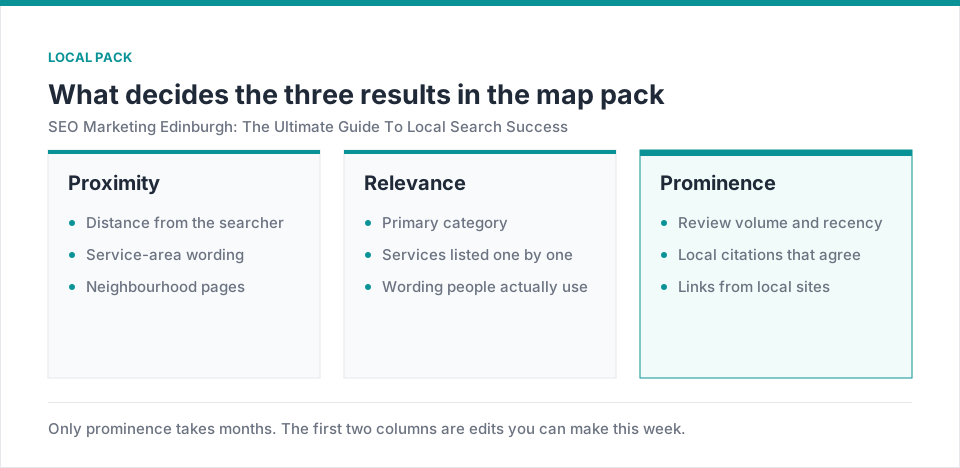
In Edinburgh, near-me and contextually relevant searches reliably convert when you provide accurate business details, timely hours, and helpful local information. Consumers frequently search for trades, hospitality, professional services, and experiences by district, whether it’s a morning coffee in Leith or a plumbers’ appointment in the Old Town. Local search signals such as NAP consistency, Google Business Profile health, and district-level knowledge panels directly influence visibility in Maps and Local Packs.
A robust Edinburgh strategy also supports tourism-driven traffic by surfacing event calendars, local partnerships, and seasonal promotions when visitors or residents search for activities around the Royal Mile, Edinburgh Castle, or Princes Street. A governance-first approach ensures every optimisation delta is documented, auditable, and regulator-ready for reviews by stakeholders and regulators.
- Proximity and local intent matter more in Edinburgh’s compact geography.
- Accurate NAP data and GBP health improve near-me visibility across districts such as Old Town, New Town, Leith, and Stockbridge.
- Local pages, event calendars and district FAQs increase relevance for readers in each area.
- A governance framework provides traceability for audits and performance reviews.
Eight-surface diffusion: the Edinburgh framework
Successful Edinburgh SEO operates across eight interconnected surfaces: Maps, Local Pages, Knowledge Panels, Discover experiences, Copilots, Brand Stores, the Brand Website, and GBP health signals. This architecture lets you preserve a durable spine_topic while surfacing local nuance through district wrappers—local calendars, neighbourhood questions, and service expectations that readers in Leith, Old Town, or Morningside recognise as highly relevant. Governance artefacts travel with every delta to support audits and regulator-ready reporting.
- Maps.
- Local Pages.
- Knowledge Panels.
- Discover experiences.
- Copilots.
- Brand Stores.
- The Brand Website.
- GBP health signals.
A practical Edinburgh strategy
Begin with a tight discovery to align spine_topic with target Edinburgh districts such as Old Town, New Town, Leith, Stockbridge, and Murrayfield. Build district wrappers that surface local intent without diluting the core message. Start with robust GBP health, NAP consistency across directories, and Local Pages scaffolds that answer common district questions, events, and services.
Alongside this, implement district-specific content calendars, and ensure on-page elements — titles, headers, and meta descriptions — reinforce both the spine_topic and district intent. Governance artefacts will travel with every delta, creating a traceable history of decisions across eight surfaces.
Next steps for Edinburgh businesses
If you are evaluating Edinburgh SEO partners or consultants, start with a concise strategy session to validate spine_topic fidelity, district wrappers, and governance readiness. Use the Edinburgh Services hub to explore core offerings, the Resources hub for governance artefacts, and the Contact page to schedule a strategy session.
Internal links: SEO Services hub, Resources hub, and Contact page.
Part 2: Developing a Local SEO Strategy for Edinburgh
Edinburgh’s distinctive mix of historic commerce, academic activity, and a resilient visitor economy means local search requires more than a generic optimisation push. A local SEO strategy built for Edinburgh starts with a precise spine_topic—the durable core message that reflects your brand’s value—and threads district-level nuance through eight diffusion surfaces: Maps, Local Pages, Knowledge Panels, Discover experiences, Copilots, Brand Stores, the Brand Website, and GBP health signals. This part details how to translate that spine_topic into district-aware actions while maintaining governance-ready provenance for audits and regulator reviews. At edinburghseo.org we champion a governance-forward approach, ensuring every delta travels with auditable provenance from day one.
1) Establish clear local goals aligned to Edinburgh districts
Begin by mapping your spine_topic to key Edinburgh districts where you expect the strongest local demand: Old Town, New Town, Leith, Stockbridge, and Murrayfield, among others. For each district, define measurable outcomes such as increased footfall to physical locations, enhanced appointment requests, or higher contact form submissions. Tie these outcomes to the eight-surface diffusion model so that you can observe how district wrappers influence Maps impressions, Local Pages engagement, and GBP health signals without disturbing the spine_topic’s core message.
This governance-first alignment ensures stakeholders can replay decisions language-by-language across eight surfaces, with a clear link from district activity to business goals. When possible, attach a per-district KPI slate to the main dashboard so leadership can assess district momentum in tandem with overall branding stability.
2) GBP health and NAP consistency across Edinburgh directories
Google Business Profile health is foundational for near-me searches and store visits. Start with a GBP health audit for Edinburgh locations, ensuring all business details (NAP) are consistent across major directories and mapped to the Edinburgh spine_topic. Regularly verify hours, locations, and service areas, and leverage GBP posts to highlight local events or seasonal promotions that align with district calendars. A robust NAP strategy across directories reduces confusion for customers and bolsters local pack impressions in Maps.
Synchronise GBP data with on-site Local Pages that reflect district intent. For example, a Leith-specific page could emphasise harbour-side services and event ties, while a Murrayfield page spotlights sports and community activities. This approach preserves spine_topic semantics while surfacing district-specific relevance in eight diffusion surfaces.
3) District wrappers and local landing pages
District wrappers act as contextual layers that surface local intent without fracturing the spine_topic. Create Local Pages for Old Town, Leith, Stockbridge, and other high-potential areas, each with district-specific FAQs, service offerings, event calendars, and neighbourhood questions. Ensure wrappers reference the core services in a way that is meaningful for each locale, while the overarching spine_topic remains intact across Maps, Local Pages, Knowledge Panels, Discover experiences, Copilots, Brand Stores, the Brand Website, and GBP health signals.
Adopt a consistent content architecture: district pages link back to pillar topics, maintain cohesive internal linking, and employ structured data to describe local products, services, and events. Governance artefacts should travel with every delta to support regulator-ready reporting and easy audit trails.
4) Content calendars and local relevance
A practical Edinburgh calendar weaves evergreen pillar content with district-specific prompts. Plan content around local events such as festivals, academic calendars, and popular seasonal activities that drive local search spikes. Each content block should diffuse across the eight surfaces, maintaining semantic stability while surfacing district-centric details, such as Leith harbour events on Local Pages or Old Town walking tours in Knowledge Panels. Governance artefacts accompany every delta to enable regulator-ready audits and explain how local nuance aligns with the spine_topic.
Examples of district-focused content themes include: how-to guides for Edinburgh tourist experiences, case studies from local businesses, neighbourhood spotlights, and seasonal service calendars that tie to district calendars and events.
5) Technical readiness for eight-surface diffusion
Technical SEO underpins the eight-surface model. Prioritise crawlability, mobile speed, and robust structured data for LocalBusiness and district entities. Implement schema that accurately reflects Edinburgh’s geography, including districts, venues, and events, so search engines interpret local facts correctly across Maps, Local Pages, Knowledge Panels, Discover experiences, Copilots, Brand Stores, the Brand Website, and GBP health signals. Regular audits should verify canonicalisation, duplicate content management, and correct geo-tagging for district content.
Governance artifacts accompany every delta, ensuring language-by-language provenance is preserved for regulator reviews. Maintain a shared repository of templates and checklists so teams can reproduce Edinburgh diffusion at scale without sacrificing semantic integrity.
6) Governance, dashboards, and district accountability
Establish per-district dashboards that show surface performance, GBP health, and Local Pages engagement. Attach CORA Trails for inputs and decisions, Translation Memories for locale-consistent phrasing, and RegExports By Design for regulator-ready exports with every delta. A quarterly governance review compares district diffusion momentum to spine_topic outcomes, ensuring parity across eight surfaces as Edinburgh expands into additional neighbourhoods.
Internal links: visit our SEO Services hub for dashboards templates and the Resources hub for governance artefacts that support district readiness across Edinburgh. Use the Contact page to arrange a strategy session tailored to your Edinburgh diffusion plan.
Part 3: Keyword Research For Edinburgh Audiences
Edinburgh’s local market blends historic tourism, a strong student and university ecosystem, and a thriving professional services scene. Robust keyword research for seo marketing edinburgh starts with identifying the spine_topic that travels across eight diffusion surfaces—Maps, Local Pages, Knowledge Panels, Discover experiences, Copilots, Brand Stores, the Brand Website, and GBP health signals—while surfacing district-level nuance for readers in Edinburgh’s neighbourhoods. At edinburghseo.org we approach this work with a governance-forward mindset, ensuring keyword decisions come with auditable provenance from day one.
1) Mapping Local Intent Across Edinburgh Districts
Begin by translating city-wide search interest into district-focused intent. Core districts such as the Old Town, New Town, Leith, Stockbridge, and Morningside are anchors, but eight diffusion surfaces require wider coverage to capture travel, housing, hospitality, and professional services. Build a district intent map that pairs common searches with reader needs in each area—for example, pedestrian-friendly experiences in the Old Town or harbour-oriented services in Leith. This map should align with the spine_topic so that the central value proposition remains recognisable across eight surfaces while district wrappers surface local relevance.
Practical steps include: identifying top district-specific queries, validating them against GBP insights, and linking them to the main service pillars you offer. The governance framework travels with every delta, preserving language-by-language provenance for regulator-ready reporting across Maps, Local Pages, Knowledge Panels, Discover experiences, Copilots, Brand Stores, the Brand Website, and GBP health signals.
- Old Town, New Town, Leith, Stockbridge, and Morningside anchor district intent.
- Map district-level queries to eight-surface diffusion signals.
- Capture district calendars and events to align with seasonal local searches.
2) Core Edinburgh Keyword Clusters
Clause-by-clause, build keyword clusters that reflect Edinburgh’s distinctive search landscape. The primary cluster should include core branded terms that mix location with service, such as seo marketing edinburgh, edinburgh seo services, and edinburgh seo company. Supplement with district-aligned clusters that address reader needs in specific neighbourhoods, while preserving spine_topic integrity across eight surfaces. Typical clusters include technical SEO, local optimisation, GBP health, content strategy, and performance analytics tailored to Edinburgh’s business mix.
Key clusters to prioritise now include:
- Core Edinburgh brand terms: seo marketing edinburgh, edinburgh seo, seo Edinburgh.
- Local intent and district pages: edinburgh old town seo, edinburgh leith local seo, edinburgh stockbridge seo services.
- Service-specific clusters: technical SEO Edinburgh, local page optimisation Edinburgh, GBP optimisation Edinburgh.
3) Long-Tail And Event-Driven Keywords
Edinburgh’s events calendar and local attractions create fertile ground for long-tail queries. Include phrases that reflect seasonal patterns, tourism demand, and district-specific concerns. Examples to test and rank for include: edinburgh fringe festival seo, edinburgh castle visitor information SEO, edinburgh cafe near royal mile SEO, best seo company in edinburgh, edinburgh digital marketing agency, and local SEO Edinburgh Old Town. Long-tails tied to events (How to optimise around the Edinburgh Festival, Leith海를 이용한 콘텐츠 아이디어) help capture timely intent while reinforcing the spine_topic across eight surfaces.
For governance, attach CORA Trails for inputs, Translation Memories for locale-consistent phrasing, and RegExports By Design for regulator-ready exports as you experiment with these phrases across surfaces.
4) Keyword Research Workflow And Governance
Adopt a repeatable workflow that starts with discovery, then builds clusters, validates intent signals, and outputs per-district keyword maps that feed all eight diffusion surfaces. Each stage should be accompanied by governance artefacts to support audits and regulator-ready reporting. The process should ensure that keywords surface local nuance without compromising the spine_topic, and that data hygiene is maintained across Edinburgh’s directories and GBP health signals.
Recommended workflow elements include: district-level validation, per-surface keyword mapping, and District WRappers that surface local intent in Local Pages and Knowledge Panels while keeping the core spine_topic stable. Governance attachments travel with every delta, enabling language-by-language replay and auditable provenance across Maps, Local Pages, Knowledge Panels, Discover experiences, Copilots, Brand Stores, the Brand Website, and GBP health signals.
- Discovery to identify core districts and intents.
- Keyword clustering and district wrappers alignment.
- Per-surface mapping and governance attachment.
5) Practical Output: An Edinburgh Keyword Map
Conclude with a tangible keyword map that pairs district wrappers with eight-surface diffusion signals. For Old Town, Leith, and Stockbridge, present clusters that cover core services, district events, and evergreen content. Each entry should indicate which diffusion surface it most strongly serves (Maps for near-me visibility, Local Pages for district relevance, GBP posts for events, Knowledge Panels for service data, Discover experiences for experiences, Copilots for guided journeys, Brand Stores for product discovery, the Brand Website for conversion, GBP health signals for ongoing credibility). Use this map to drive content calendars, on-page optimisations, and governance documentation, all connected to the spine_topic and with auditable provenance from day one.
Internal links: explore our SEO Services hub for district-focused implementations, the Resources hub for governance artefacts, and the Contact page to discuss Edinburgh-specific diffusion.
Part 4: On-Page Optimisation For Edinburgh Websites
Edinburgh’s local landscape requires on-page optimisation that respects district nuance while preserving the spine_topic—seo marketing edinburgh—as the durable core message across eight diffusion surfaces: Maps, Local Pages, Knowledge Panels, Discover experiences, Copilots, Brand Stores, the Brand Website, and GBP health signals. This section translates keyword research and district wrappers into practical on-page actions that improve relevance, readability, and conversion for Edinburgh audiences. At edinburghseo.org we emphasise governance-forward practice, ensuring every on-page delta carries auditable provenance from day one.
1) Core On-Page Fundamentals For Edinburgh
Start with titles that integrate the spine_topic and local context, for example seo marketing edinburgh paired with the business name. Keep meta descriptions informative and action-driven, highlighting district relevance such as Old Town or Leith while avoiding keyword stuffing. Ensure H1 encapsulates the spine_topic and that subsequent headers (H2, H3) reflect district wrappers without diluting the core message.
On-page copy should prioritise natural language, clear benefits, and district-anchored intents. Use Edinburgh-specific terms where appropriate (for instance, references to local landmarks, districts, or seasonal events) to improve alignment with reader expectations without compromising the spine_topic across eight surfaces.
Internal links should reinforce the diffusion model. Link from district wrappers to pillar topics on the Brand Website, Local Pages toGBP health content, and Knowledge Panels to service data blocks. Governance artefacts accompany each delta to support regulator-ready reporting and auditable language histories.
2) District Pages And Local Landing Pages
Develop Local Pages for Edinburgh districts with wrappers that surface local questions, event calendars, hours, and district-specific services. For example, a Local Page for Old Town might feature walking-tour FAQs, heritage-related services, and nearby partner recommendations, while a Leith page could emphasise harbour-based activity and seasonal tours. Each district page should link back to core pillar topics and maintain consistent NAP (Name, Address, Phone) data to support GBP health and local packs.
Apply structured data that mirrors Edinburgh’s geography, including district entities and event data. Use LocalBusiness and Organisation schemas to describe the business and its Edinburgh reach, and include FAQPage markup to answer common district questions. Governance artefacts travel with every delta to ensure regulator-ready provenance across Maps, Local Pages, and GBP health signals.
3) Schema Markup And Local Entities
Schema markup should clearly describe Edinburgh-specific facts. Use LocalBusiness or Restaurant (where applicable) for location-based services, include geographic coordinates, opening hours, and service areas that reflect the city’s districts. Add BreadcrumbList to help search engines understand site structure from the user’s Edinburgh journey. FAQPage markup on Local Pages surfaces district-specific questions and answers, reinforcing the Edinburgh context while the spine_topic remains the anchor.
Knowledge Panel enrichments can be bolstered by accurate service data, reviews, and up-to-date business details that align with district calendars. Regular governance checks ensure canonical pages remain aligned with the eight-surface diffusion model and regulator-ready exports accompany every delta.
Read next: Edinburgh SEO company: how they work · SEO specialist Edinburgh: the brief
4) Content Structure And Readability
Organise content into scannable blocks that guide readers from discovery to action. Use short paragraphs, informative subheadings, and bullet lists to outline services, events, and district-specific propositions. Each block should diffuse across Maps, Local Pages, Knowledge Panels, Discover experiences, Copilots, Brand Stores, the Brand Website, and GBP health signals without diluting the spine_topic. Maintain a consistent voice and tone across districts to support trust and recognisability.
Content briefs tied to the spine_topic should specify target districts, user intent, and required formats (landing pages, FAQs, case studies) to ensure that every content asset contributes to the eight-surface diffusion while preserving semantic stability.
5) Internal Linking And Navigation For Edinburgh
Design internal links that guide users through Edinburgh’s district journey. Use district wrappers to connect Local Pages with pillar topics, Guides with event calendars, and service pages with district FAQs. A deliberate linking pattern helps search engines interpret relationships between Edinburgh districts and your core offerings, enhancing Maps visibility and Local Pack relevance while keeping the spine_topic intact.
Implement a clear breadcrumb trail that mirrors Edinburgh’s geography and site structure, supporting both user navigation and search engine understanding. Governance artefacts should accompany every delta to enable language-by-language replay and regulator-ready reporting across eight surfaces.
6) Local Signals And GBP Health Alignment On-Page
On-page changes should synchronise with GBP health signals such as updated hours, accurate service areas, and district-specific posts. Ensure Local Pages reference GBP posts for events and promotions relevant to Edinburgh readers. Keep NAP consistent across directories and reflect local calendars in Local Page content where appropriate. Governance artefacts travel with every delta to provide auditable provenance and enable regulator-ready reporting across Maps, Local Pages, Knowledge Panels, Discover experiences, Copilots, Brand Stores, the Brand Website, and GBP health signals.
7) Governance, Dashboards And Per-District Accountability
All on-page activities should be governed with artefacts that move with every delta. Attach CORA Trails for inputs and decisions, Translation Memories for locale-consistent phrasing, and RegExports By Design for regulator-ready exports. Establish per-district dashboards to monitor how on-page optimisations contribute to Maps impressions, Local Pages engagement, and GBP health signals, while ensuring spine_topic fidelity remains intact across eight diffusion surfaces.
Internal links: visit our SEO Services hub for on-page templates, the Resources hub for governance artefacts, and the Contact page to schedule Edinburgh-focused strategy sessions.
Part 5: Technical SEO Essentials For Local Edinburgh Sites
Edinburgh’s local economy relies on more than attractive storefronts and footfall. Technical SEO forms the quiet backbone that makes all eight-diffusion surfaces work together with speed, clarity, and trust. This part translates the eight-surface diffusion framework into practical, Edinburgh-focused technical actions that protect spine_topic fidelity—seo marketing edinburgh—while surfacing district nuance across Maps, Local Pages, Knowledge Panels, Discover experiences, Copilots, Brand Stores, the Brand Website, and GBP health signals. At edinburghseo.org we embed governance artefacts with every delta to ensure regulator-ready provenance from day one.
Technical readiness is not a one-off task. It is an ongoing discipline that keeps Edinburgh’s local signals accurate, crawlable, and fast for users who search for nearby services, events, and amenities in districts like Old Town, Leith, Stockbridge, and Morningside.
1) Crawlability And Indexability For Edinburgh
Begin with a clean crawl path that aligns district wrappers with the spine_topic. Create a concise, robot-friendly sitemap.xml that emphasises Local Pages and district anchors while avoiding duplicate indexing of wrapper content. Use robots.txt to restrict non-essential duplication across eight diffusion surfaces and keep essential Edinburgh signals easily discoverable. Regularly audit crawl errors, log file anomalies, and index coverage to ensure search engines can surface district-level information such as local services, events, and neighbourhood questions promptly.
Key governance artefacts travel with every delta to support regulator-ready reporting, including a district diffusion map and per-surface crawl-bug fixes. For reference, align with Google’s guidance on crawlability and indexability and consult official documentation when implementing schema and structured data for LocalBusiness and district entities.
- Crawlable district wrappers should be discoverable from pillar topics without creating content silos that obscure the spine_topic.
- Submit a clean, Edinburgh-focused sitemap and maintain up-to-date robots.txt rules for Maps, Local Pages, and GBP health signals.
- Monitor and fix crawl errors by district, then validate index coverage per surface and language.
2) Mobile Speed And Core Web Vitals For Local Edinburgh
Performance is a local necessity. Core Web Vitals underpin user experience across mobile and desktop, influencing Maps proximity, Local Pages engagement, and GBP health signals. Target fast time-to-interactive (TTI), minimal layout shift (CLS), and large contentful paint (LCP) improvements across Edinburgh districts. Prioritise critical resources, optimise server response times, and implement image optimisations that respect Edinburgh’s content needs—event calendars, district FAQs, and local service details—without compromising the spine_topic.
Adopt a governance-driven performance plan: quarterly speed audits, per-district performance baselines, and surface-specific optimisation roadmaps. Align with credible external sources such as Google’s performance guidance and industry best practices to maintain regulator-ready provenance for performance signals in eight diffusion surfaces.
- Establish district-level performance baselines for Maps, Local Pages, and GBP health signals.
- Prioritise per-surface speed improvements that have the largest impact on user experience in Edinburgh districts.
- Document performance changes with CORA Trails and Translation Memories to support auditability across languages and surfaces.
3) Structured Data And Local Entities
Structured data is the language search engines use to understand Edinburgh’s local reality. Implement LocalBusiness, Organization, and Place schemas with explicit geographic coordinates, opening hours, service areas, and district affiliations. Extend with Event, LocalBusinessDetail, and FAQPage schemas that reflect Old Town, Leith, and other districts’ common questions. Use per-surface schema variants that surface in Maps, Local Pages, and Knowledge Panels while preserving the spine_topic across eight diffusion surfaces.
Governance artefacts accompany each delta: CORA Trails capturing decisions, Translation Memories for locale-accurate phrasing, and RegExports By Design to package regulator-ready exports. Validate structured data with test tools and align with Google’s official guidelines to ensure long-term compatibility and auditability.
- Describe district entities (Old Town, Leith, Stockbridge) with precise geo-coordinates and service areas.
- Use Event markup for local happenings to improve Discover experiences and Local Pages relevance.
- Employ FAQPage markup on Local Pages to surface common Edinburgh questions and answers.
4) Canonicalisation, Duplicate Content And Local Pages
Across Edinburgh’s eight diffusion surfaces, preventing content duplication is critical. Use canonical tags thoughtfully to signal the preferred version of product, service, and district pages. Where wrappers surface similar intents across Old Town and New Town, implement hreflang where relevant and ensure wrappers reference the core pillar pages without duplicating core content. Maintain a strict policy for cross-district content reuse that preserves spine_topic stability while allowing district-level nuances to surface on Local Pages and Knowledge Panels.
Governance artefacts should travel with each delta, including a canonical strategy, per-district content blocks, and audit-ready exports. Regularly review duplicate content reports and adjust wrappers to maintain semantic integrity across eight diffusion surfaces.
- Use canonical tags to identify the primary page for district content where appropriate.
- Implement hreflang for language and region where Edinburgh audiences vary by language or market.
- Maintain a central repository of per-district blocks to minimise content duplication while preserving local relevance.
5) Internal Linking Architecture For Edinburgh Diffusion
Internal linking should guide readers through Edinburgh’s district journey while preserving spine_topic fidelity. Create hub pages that anchor eight-surface diffusion and link to Local Pages wrappers, district calendars, and event blocks. Use purposeful anchor text that communicates district relevance without diluting the core message. A clear breadcrumb trail reflecting Edinburgh’s geography helps readers and search engines understand site structure across Maps, Local Pages, Knowledge Panels, Discover experiences, Copilots, Brand Stores, the Brand Website, and GBP health signals.
Governance artefacts travel with every delta, including CORA Trails for inputs and decisions, Translation Memories for locale-consistent phrasing, and RegExports By Design for regulator-ready exports. Maintain a central content hub that supports scalable internal linking while keeping the spine_topic intact across eight diffusion surfaces.
- Link Local Pages wrappers back to pillar topics on the Brand Website.
- Cross-link district calendars and district FAQs to enhance local relevance.
- Preserve a clean breadcrumb trail aligned with Edinburgh’s districts (Old Town > Leith > Stockbridge, etc.).
6) Governance, Dashboards And Auditability
All technical SEO work must travel with auditable provenance. Attach CORA Trails for inputs, Translation Memories for locale phrasing, and RegExports By Design for regulator-ready exports with every delta. Establish per-district dashboards that monitor crawl health, index coverage, page speed, and per-surface performance. Conduct quarterly governance reviews to ensure spine_topic fidelity while district wrappers surface local nuance, and maintain regulator-ready exports for audits across Maps, Local Pages, Knowledge Panels, Discover experiences, Copilots, Brand Stores, the Brand Website, and GBP health signals.
Internal links: visit our SEO Services hub for technical templates, the Resources hub for governance artefacts, and the Contact page to discuss Edinburgh-specific diffusion with regulator-ready provenance.
Part 6: Local Link Building And Digital PR In Edinburgh
Local link building and digital PR are not about random backlinks; they’re about cultivating credible signals from Edinburgh’s influential local ecosystems. In the eight-surface diffusion model, high-quality local mentions—Maps, Local Pages, Knowledge Panels, Discover experiences, Copilots, Brand Stores, the Brand Website, and GBP health signals—start with trustworthy Edinburgh-based relationships. This part translates those relationships into a repeatable, governance-forward playbook that preserves spine_topic fidelity while surfacing district nuance across the city’s neighbourhoods.
1) Build a Local Ecosystem Of Edinburgh Backlinks
Forward-looking Edinburgh link strategies begin with identifying high-authority, locally relevant domains. Target city centre publications, district business associations, universities, cultural institutions, and tourism partners that publish regular updates about events, services, and local achievements. The goal is to secure editorially placed links and contextually relevant mentions, not generic directory listings. Each outreach delta should travel with CORA Trails for inputs, Translation Memories for locale-consistent phrasing, and RegExports By Design to ensure regulator-ready exports accompany any outreach activity.
- Prioritise Edinburgh-specific outlets with established local readership and clear relevance to your spine_topic.
- Bundle outreach with district calendars and events to maximise relevance and linkability.
- Document outreach decisions in CORA Trails and preserve translations in Translation Memories for multi-district reuse.
- Package evidence of placements with RegExports By Design for regulator-ready reporting across eight surfaces.
2) Local Citations And GBP-Driven Links
Local citations remain a foundational component of Edinburgh’s near-me signals. Build NAP-consistent citations across Edinburgh directories, university partner listings, and community organisations aligned with your spine_topic. When possible, secure citations from sources that regularly publish about local services or events, which helps GBP health signals and local packs. Each citation should be tracked with CORA Trails, and translations should be stored in Translation Memories to ensure consistent phrasing across languages or dialects within Edinburgh’s markets.
Integrate citation activity with Local Pages content so readers encounter congruent local information. For example, Leith-focused pages can reference harbour-related services while Old Town pages highlight heritage walking tours. Governance artefacts travel with each delta to support regulator-ready reporting and per-district accountability across eight diffusion surfaces.
3) Digital PR And Local Events In Edinburgh
Edinburgh’s calendar is packed with festivals, university activities, and cultural happenings. Design Digital PR campaigns around local events to create timely, linkable content that resonates with residents and visitors. For instance, guides to walking routes around the Royal Mile, behind-the-scenes looks at festivals, or partner spotlights with Edinburgh businesses can attract editorial coverage and natural backlinks. Ensure every PR delta is linked to the district wrappers and the spine_topic to maintain coherence across Maps, Local Pages, Knowledge Panels, Discover experiences, Copilots, Brand Stores, the Brand Website, and GBP health signals. All outreach should be logged in CORA Trails with locale-appropriate phrasing in Translation Memories and regulator-ready packaging in RegExports By Design.
- Coordinate PR calendars with local partners to secure timely coverage and quality backlinks.
- Publish district-tailored PR assets that map back to Local Pages and pillar topics.
- Document outreach rationale and results in governance artefacts for audits across eight surfaces.
4) Linkable Content Assets For Edinburgh
Create evergreen, link-worthy content that naturally earns referral traffic. Ideas include: expert roundups on Edinburgh’s local SEO landscape, historic walking guides, district-focused case studies, and data-rich reports about local consumer behaviour. When these assets are created, diffuse them across eight surfaces so that Maps, Local Pages, Knowledge Panels, Discover experiences, Copilots, Brand Stores, the Brand Website, and GBP health signals all benefit from cohesive, high-quality content. Governance artefacts accompany each delta to enable regulator-ready replay across languages and districts.
Content formats should be modular: hero guides anchored to spine_topic, district wrappers with FAQs, and event calendars that feed Local Pages and GBP posts. Internal linking should support diffusion without diluting the core message. Per-district content blocks should be reusable yet distinct enough to reflect Edinburgh’s rich variety.
5) Governance, Measurement And Collaboration
Maintain auditable provenance for all locallink and PR activity. Attach CORA Trails to record outreach inputs and decisions, Translation Memories to preserve locale-consistent phrasing, and RegExports By Design for regulator-ready exports. Establish per-district dashboards to monitor link quality, GBP health signals, and Local Pages engagement. Quarterly governance reviews should assess the alignment between district wrappers and spine_topic across eight diffusion surfaces, ensuring that local links strengthen proximity signals without compromising semantic integrity.
Internal links: consult the SEO Services hub for outreach templates, the Resources hub for governance artefacts, and the Contact page to schedule Edinburgh-focused strategy sessions.
Part 7: Content Marketing for Edinburgh Markets
Edinburgh’s distinctive blend of tourism, academia, and a thriving local economy means content marketing for this market must unify a strong spine_topic with district-level nuance. The durable core message remains seo marketing edinburgh, but district wrappers surface local intent across Maps, Local Pages, Knowledge Panels, Discover experiences, Copilots, Brand Stores, the Brand Website, and GBP health signals. This Part 7 outlines a practical, governance-forward content framework that translates Edinburgh readers’ needs into timely, local, and actionable content while preserving semantic stability across eight diffusion surfaces.
1) Define Edinburgh-centric content goals aligned to districts
Start with district-based objectives that harmonise with the spine_topic. For example, Old Town may prioritise heritage experiences and walking itineraries, Leith could emphasise harbour activities and seasonal tours, while Stockbridge might focus on independent shops and weekend markets. Each district target should map to eight-diffusion surfaces so readers encounter coherent messages whether they discover content on Maps, Local Pages, or Discover experiences. This governance-forward approach ensures every piece of content carries auditable provenance from day one.
Set concrete outcomes such as increased event traffic to Local Pages, higher GBP engagement through district posts, and richer entry points on the Brand Website that convert local interest into inquiries or bookings. Attach district-specific KPIs to a central spine_topic dashboard so leadership can review progress in parallel with overall branding stability.
2) Choose Edinburgh-friendly content formats
Develop a modular content system that supports eight-surface diffusion while remaining recognisable to readers. Core formats include pillar guides anchored to the spine_topic, district wrappers with local FAQs and event calendars, case studies featuring Edinburgh businesses, and evergreen how-to content about navigating the city’s attractions. Pair evergreen content with timely, event-driven assets for Fringe, festivals, university terms, and seasonal tourism patterns to capture spikes in search interest across districts.
Structure content so it can be repurposed across surfaces. For instance, a walking-tour guide can become a Local Page, a Knowledge Panel data block, and a Discover experience entry, all linking back to pillar topics on the Brand Website.
3) District wrappers: surf local intent without fracturing the spine_topic
District wrappers act as contextual layers that surface local needs while keeping the spine_topic intact. Create Local Pages for Old Town, Leith, Stockbridge, Murrayfield, and other high-potential areas, each with district-specific FAQs, calendars, and services. Ensure wrappers reference the core services in a way that resonates locally, while the eight-diffusion surfaces collectively reinforce the Edinburgh market’s overall value proposition.
Couple wrappers with structured data to describe local services and events. Governance artefacts should travel with every delta, enabling regulator-ready reporting and easy audit trails across Maps, Local Pages, Knowledge Panels, Discover experiences, Copilots, Brand Stores, the Brand Website, and GBP health signals.
4) Content calendars and local relevance
Face Edinburgh’s calendar with a content calendar that blends pillar themes and district events. Schedule Edinburgh-focused campaigns around the Fringe, winter festivals, academic year milestones, and popular local activities. Ensure each block diffuses across the eight surfaces, surfacing district-specific details (Old Town heritage trails, Leith harbour tours) while maintaining spine_topic fidelity.
Synchronise calendars with GBP health updates so that timely posts align with local hours, service areas, and promotions. Governance artefacts accompany every delta to support regulator-ready reporting and provide a clear audit trail across eight surfaces.
5) Distribution and cross-surface diffusion
Plan deliberate diffusion across eight surfaces. Maps benefit from proximity-forward content like district event roundups and walking routes; Local Pages surface district FAQs and calendars; Knowledge Panels reflect local service data and snippets; Discover experiences showcase Edinburgh activities; Copilots guide readers through district journeys; Brand Stores highlight district-specific offerings; the Brand Website converts visitors into leads; GBP health signals remain consistent with on-page content. Each piece of content should include a clear path back to the spine_topic and district wrappers.
Maintain an auditable provenance trail for every delta, using CORA Trails to log inputs and decisions, Translation Memories for locale-consistent phrasing, and RegExports By Design to package regulator-ready exports for audits across eight surfaces.
6) Governance, artefacts and measurement
Content marketing in Edinburgh should be governed with artefacts that travel with every delta. Attach CORA Trails for decisions, Translation Memories for locale-consistent phrasing, and RegExports By Design for regulator-ready exports. Implement per-district content calendars and dashboards that reveal how eight-surface diffusion supports spine_topic fidelity and district-level engagement. Regular governance reviews help ensure content remains timely, relevant, and compliant with local expectations.
Internal links: explore our SEO Services hub for content templates, the Resources hub for governance artefacts, and the Contact page to discuss Edinburgh-driven diffusion with regulator-ready provenance.
Part 8: Google Business Profile And Local Listings
Edinburgh is a city where proximity and trust matter as much as on-page content. Google Business Profile (GBP) health and accurate local listings are foundational signals that influence Maps visibility, Local Pack eligibility, and near-me searches across eight diffusion surfaces: Maps, Local Pages, Knowledge Panels, Discover experiences, Copilots, Brand Stores, the Brand Website, and GBP health signals. This part builds on Part 7 by showing how GBP optimisations and local listings integrate with district wrappers to sustain a governance-forward Edinburgh diffusion strategy at edinburghseo.org.
From a governance perspective, every GBP adjustment travels with provenance artefacts. CORA Trails capture inputs and decisions; Translation Memories preserve locale-consistent phrasing; RegExports By Design packages regulator-ready exports for audits. This ensures Edinburgh’s GBP health improvements aren’t isolated changes but part of a traceable, auditable diffusion across eight surfaces.
1) GBP health audit for Edinburgh locations
Begin with a comprehensive GBP health audit across all Edinburgh locations. Validate core business details (NAP), categories, service areas, and attributes to ensure uniform interpretation by search engines. Confirm that hours, phone numbers, and addresses match across important directories and Local Pages wrappers. A healthy GBP profile feeds Maps impressions, improves local pack placements, and supports event-driven content in district calendars. This audit should be repeated quarterly, with governance artifacts attached to each delta so leadership can replay decisions language-by-language across eight diffusion surfaces.
Practical steps include mapping Edinburgh districts to GBP locations, aligning GBP posts with district calendars, and ensuring service-area definitions reflect local reader expectations (for example, Old Town heritage services or Leith harbour activities). Link GBP health work to Local Pages scaffolds so district intents surface coherently in eight diffusion surfaces.
2) Consistent NAP across Edinburgh directories
Consistency of the Name, Address and Phone (NAP) is the backbone of credible local signals. Run a systematic sweep across Edinburgh directories, GP listings, university partner pages, and local business directories to ensure NAP parity. Where differences exist, implement a single source of truth and propagate changes through CORA Trails so each surface can replay the provenance of the decision. Synchronising NAP with Local Pages wrappers, district calendars, and GBP posts reinforces proximity signals and reduces user confusion when transitioning from Maps to the Brand Website.
In practice, maintain a district-level NAP map that feeds into GBP health dashboards and Local Pages scaffolds. This keeps district readers anchored to accurate information while enabling auditability across eight diffusion surfaces.
3) District wrappers and Local Page integration
District wrappers are contextual layers that surface local intent without diluting the spine_topic seo marketing edinburgh. Create Local Pages for Old Town, Leith, Stockbridge, and other high-potential districts, each with district FAQs, event calendars, and service listings that mirror GBP post activity. Ensure wrappers reference the core services while surfacing local nuances, so readers encounter consistent signals across Maps, Local Pages, Knowledge Panels, and Discover experiences. Governance artefacts travel with every delta to support regulator-ready reporting and auditable provenance across eight surfaces.
Implement structured data on Local Pages that aligns with GBP signals: LocalBusiness schema, Event schema for district happenings, and FAQPage markup to answer common district questions. This structural alignment strengthens the King’s cross-surface coherence and the Edinburgh diffusion narrative.
4) Reviews, responses, and reputation signals
Reviews are a trust signal that translates directly into click-through and conversion. Establish a district-responsive review management approach: monitor sentiment per district, respond promptly, and address recurring themes in a public, solution‑oriented tone. Tie review responses to Local Pages content where appropriate and use GBP posts to highlight resolved issues or new services tied to district calendars. Governance artefacts capture the rationale for responses and outcomes of each interaction, enabling auditability across Maps, Local Pages, Knowledge Panels, Discover experiences, Copilots, Brand Stores, the Brand Website, and GBP health signals.
Encourage customers to leave reviews after district events or service interactions. Integrate these reviews into governance dashboards to demonstrate how customer feedback informs district wrappers and eight-surface diffusion momentum.
5) Knowledge panels, local data accuracy and event signals
Knowledge Panels benefit from accurate local data that mirrors GBP details. Ensure that Local Business data, hours, locations, and event information present consistently across Knowledge Panels and Local Pages. Use Event markup to surface Edinburgh district events and tie them to GBP posts and Local Pages, creating a cohesive user journey from search results to engagement on the Brand Website. Maintain governance artefacts for every delta to enable language-by-language replay across eight surfaces and regulator-ready reporting.
Regularly audit the alignment between GBP data and Knowledge Panel content to prevent drift in service areas, categories, or addresses. This reduces confusion and strengthens authority signals across the Edinburgh diffusion framework.
6) Governance, dashboards and per-district accountability
Consolidate GBP health into per-district dashboards that tracka Maps impressions, Local Pages engagement, GBP health signals, and district-specific post activity. Attach CORA Trails for inputs and decisions, Translation Memories for locale phrasing, and RegExports By Design for regulator-ready exports with every delta. Quarterly governance reviews compare district diffusion momentum to spine_topic outcomes, ensuring parity across eight surfaces as Edinburgh expands into additional neighbourhoods. Internal links: SEO Services hub for dashboards templates, Resources hub for governance artefacts, and Contact page to arrange an Edinburgh-focused strategy session.
Part 9: Local SEO Audits: Assessing and Prioritising Improvements
Edinburgh’s local economy relies on precise, governance-forward optimisation. A formal Local SEO audit provides a structured view of how eight-surface diffusion is performing across Maps, Local Pages, Knowledge Panels, Discover experiences, Copilots, Brand Stores, the Brand Website, and GBP health signals. This audit is not a one‑off exercise; it is the start of a disciplined improvement cycle that preserves spine_topic fidelity while surface-level nuance is refined district by district. At edinburghseo.org we treat audits as artefacts that travel with every delta, enabling regulator-ready provenance from day one.
1) Establishing the audit objective and scope
Begin with a clear statement of spine_topic fidelity: seo marketing edinburgh. Define the Edinburgh districts that matter most to your business, such as Old Town, New Town, Leith, Stockbridge, and Murrayfield, and determine what performance looks like on each diffusion surface. The audit should map current signals to eight-surface diffusion outcomes and identify where district wrappers are helping or hindering the core message.
Document governance expectations from the outset so stakeholders can replay decisions language-by-language across Maps, Local Pages, Knowledge Panels, Discover experiences, Copilots, Brand Stores, the Brand Website, and GBP health signals.
2) Data collection across eight surfaces
Gather data from all eight diffusion surfaces to form a complete baseline. Capture Maps impressions by district, Local Pages engagement, GBP health status, Knowledge Panel completeness, Discover experiences resonance, Copilots guided journeys, Brand Stores interactions, and Brand Website conversions. Ensure data hygiene by aligning terminology, language variants, and temporal windows so comparisons are meaningful for governance reviews.
Attach provenance artefacts to each data pull so leadership can replay how decisions were reached when knee‑jerk shifts in search behaviour occur.
3) Local signals and NAP consistency audit
Audit Name, Address, and Phone (NAP) consistency across Edinburgh directories, GBP listings, Local Pages wrappers, and district posts. Check that hours, service areas, categories, and attributes align across surface data blocks. Any discrepancy should trigger a documented delta with corrective actions and regulator-ready packaging.
Cross-check GBP health posts against Local Pages calendars to ensure events and promotions are visible in both GBP and Local Pages surfaces, reinforcing audience expectations across districts.
4) On-page content and structural integrity audit
Review the core spine_topic across pages and ensure district wrappers surface local intent without diluting the Edinburgh message. Examine page titles, meta descriptions, headers, and on-page copy for district relevance, while keeping the eight-diffusion surface semantics intact. Audit Local Pages for FAQs, event calendars, and service listings tied to district calendars and GBP activity.
Validate structured data for LocalBusiness, Organisation, and Event markup, ensuring accurate district affiliations and real-world data accuracy across eight surfaces.
Want the numbers behind this? The analytics guide shows how organic traffic and the queries GA4 hides are rebuilt in Semalt.
5) Technical readiness and performance baseline
Assess crawlability, mobile speed, Core Web Vitals, and structured data health. Identify any page‑level performance gaps that hinder the diffusion model, such as slow Local Page load times or misconfigured schema. Establish baseline performance for each district wrapper and surface so improvements can be measured effectively over time.
Link technical findings to the governance framework, ensuring that every delta is accompanied by CORA Trails and translation tooling that preserve provenance across languages and surfaces.
6) Prioritisation framework: what to fix first
Use a practical scoring model that weighs impact on near‑me visibility, district relevance, and GBP health against effort and risk. Priority items typically include NAP harmonisation, GBP health stability, Local Page gaps, and critical structured data corrections. Create a 90‑day improvement plan with per‑surface milestones and district targets.
- Impact on Maps proximity and near‑me visibility for Edinburgh districts.
- Consistency of NAP data across major directories and GBP health.
- Completeness and accuracy of Local Pages and district wrappers.
- Technical fixes with the greatest performance uplift and governance traceability.
7) Creating the actionable improvement plan
Translate audit findings into concrete actions: per‑district Local Pages scaffolds, GBP health improvements, district‑calendars alignment, and updated schema. Assign owners, set deadlines, and attach CORA Trails, Translation Memories, and RegExports By Design to each delta. This governance‑forward package enables regulator‑ready reporting and language‑by‑language replay across eight surfaces.
Embed the improvement plan into the Edinburgh diffusion framework so updates propagate through Maps, Local Pages, Knowledge Panels, Discover experiences, Copilots, Brand Stores, the Brand Website, and GBP health signals. Link to our SEO Services hub for implementation templates and to the Resources hub for governance artefacts that support district readiness.
8) Collaboration, governance cadence, and documentation
Set up recurring governance rituals: weekly surface health standups, monthly regulator-ready exports, and quarterly audits. Define roles clearly—Client Sponsor, Edinburgh SEO Lead, District Owners, Content Lead, Data & Compliance Liaison, Technical Lead, and Governance Manager. Ensure every delta travels with CORA Trails, Translation Memories, and RegExports By Design to enable language‑by‑language replay and auditable provenance across eight diffusion surfaces.
Part 10: Measuring Success: Metrics And KPIs For Edinburgh SEO
With the eight-surface diffusion model established across Maps, Local Pages, Knowledge Panels, Discover experiences, Copilots, Brand Stores, the Brand Website, and GBP health signals, Edinburgh businesses can move from activity to accountable outcomes. This part defines a governance-forward measurement framework for seo marketing edinburgh that translates district wrappers and spine_topic fidelity into tangible ROI. All metrics are designed to be auditable, language-by-language replayable, and traceable through CORA Trails, Translation Memories, and RegExports By Design so regulators and stakeholders can see how Edinburgh’s locality signals drive business value.
A unified measurement framework for Edinburgh eight-surface diffusion
Council and client stakeholders require a single, coherent narrative showing how district wrappers contribute to spine_topic outcomes. Begin by confirming a baseline across eight surfaces for each key district (Old Town, Leith, Stockbridge, and others with high potential). Use this baseline to calibrate per-surface targets and ensure governance artefacts capture the decision rationale for every delta. The aim is to demonstrate that improvements on Local Pages or GBP health translate into Maps proximity, higher-quality Knowledge Panel data, and stronger conversions on the Brand Website, all while maintaining spine_topic integrity.
Governance artefacts travel with every delta, ensuring you can replay the rationale behind changes in audits and regulator reviews. Tie your Edinburgh diffusion roadmap to a central dashboard that presents surface health, district momentum, and ROI in business terms rather than purely technical metrics.
Per-surface KPI definitions
Eight surfaces require distinct yet complementary metrics. The following KPI framework anchors performance in Edinburgh's local context.
- Maps proximity and reach: total impressions, near-me search share, and footfall uplift attributable to Maps; data from Maps Insights and GBP-linked signals, benchmarked by district.
- Local Pages engagement: pageviews per district, average time on page, return visits, and local inquiries submitted via forms; track per-district queries and events.
- Knowledge Panels completeness: completeness score, data accuracy of local facts, and click-throughs from Knowledge Panel entries to the Brand Website or Local Pages.
- Discover experiences resonance: engagement rate with district experiences, event-driven content, and click-throughs to related assets in the Brand Website.
- Copilots guided journeys: consistency of guided journeys across districts, abandonment rate in funnels, and completion rate of district-oriented guides.
- Brand Stores performance: product views, add-to-cart rates, and stock-availability signals for district-specific offerings.
- The Brand Website conversions: form submissions, bookings, and revenue-driven actions attributable to district wrappers and on-page optimisations.
- GBP health signals: freshness of hours, service areas, categories, and GBP posts; correlation with local pack stability and review sentiment.
Benchmarking and targets
Set district-aware targets that reflect historic performance and market potential. For Edinburgh, targets should consider seasonality (festival periods, university terms) and district-specific events. Use quarterly reviews to adjust baselines and ensure eight-surface parity. Document any changes in governance artefacts to support regulator-ready exports and to preserve provenance across languages and surfaces.
Recommended practice: publish a per-district KPI slate on the central dashboard, with a clear link from each metric to spine_topic outcomes and a narrative describing how local nuance contributed to overall growth.
District-level ROI storytelling
ROI in Edinburgh emerges when district wrappers convert local interest into meaningful actions on the Brand Website and GBP health improvements cascade into Maps and Local Packs. Build district dashboards that compare pre- and post-implementation metrics, showing how wrapper content, district calendars, and event-driven pages uplift relevant signals. Tie these outcomes to a shared ROI narrative that executives can review alongside spine_topic health, ensuring governance readiness for regulator reviews.
To support audits, attach CORA Trails for decision inputs, Translation Memories for consistent phrasing across languages, and RegExports By Design for regulator-ready exports with each delta.
Data hygiene, attribution and cross-surface integrity
Accurate attribution is essential. Maintain consistent naming conventions for districts, events, and services across eight surfaces to support reliable cross-surface attribution. Implement a unified attribution model that maps district wrappers to the spine_topic, then to each diffusion surface. Regularly reconcile data across Maps, Local Pages, Knowledge Panels, Discover experiences, Copilots, Brand Stores, the Brand Website, and GBP health signals to prevent drift and ensure comparable year-over-year reporting.
Governance artefacts travel with every delta, including CORA Trails for inputs, Translation Memories for locale-specific phrasing, and RegExports By Design for regulator-ready exports. This ensures the Edinburgh diffusion story remains auditable and trustworthy as data evolve.
Dashboards, cadence, and governance cadence
Establish a predictable reporting cadence: weekly health checks for surface parity, monthly per-district dashboards, and quarterly governance reviews. Each cycle should culminate in a regulator-ready export package that consolidates CORA Trails, Translation Memories, and RegExports By Design across eight surfaces. Dashboards must be accessible to stakeholders across the eight diffusion surfaces and support language-by-language replay for audits.
Internal links: visit our SEO Services hub for dashboard templates, the Resources hub for governance artefacts, and the Contact page to discuss Edinburgh-specific measurement with governance-ready provenance.
Practical steps to implement the measurement framework
1) Validate spine_topic fidelity across eight surfaces and confirm district wrappers align with local intent. 2) Establish per-district baselines for Maps, Local Pages, GBP health, Knowledge Panels, Discover experiences, Copilots, Brand Stores, and the Brand Website. 3) Create district dashboards with clear per-surface targets and ROI narratives. 4) Attach CORA Trails, Translation Memories, and RegExports By Design to every delta for regulator-ready provenance. 5) Roll out the governance cadence, starting with two pilot districts and expanding as signal stability and governance maturity improve.
Internal links: SEO Services hub, Resources hub, and Contact page.
Part 11: Budgeting And Choosing An Edinburgh SEO Partner
Edinburgh businesses must balance long-term governance discipline with practical delivery. A budgeting approach for seo marketing edinburgh should account for eight-surface diffusion, district wrappers, and regulator-ready provenance from day one. This part outlines a pragmatic framework to set realistic budgets, select an Edinburgh partner who can scale across Maps, Local Pages, Knowledge Panels, Discover experiences, Copilots, Brand Stores, the Brand Website, and GBP health signals, and ensure outcomes are auditable and aligned with business goals.
1) Budgeting for Edinburgh SEO: what to expect
Costs vary with scope, district coverage, and governance requirements. A typical Edinburgh engagement starts with a discovery and baseline audit, followed by a multi-surface diffusion programme. Monthly retainers for small Edinburgh businesses often range from £1,000 to £3,500, with mid-market initiatives typically between £3,500 and £8,000. Larger, enterprise-scale diffusion that reaches multiple districts can exceed £10,000 per month, depending on the volume of Local Pages wrappers, GBP health optimisations, and content calendars required to surface local relevance across eight surfaces. All pricing should include governance artefacts—CORA Trails for inputs and decisions, Translation Memories for locale-consistent phrasing, and RegExports By Design for regulator-ready exports—so every delta ships with auditable provenance.
Plan for upfront setup costs to establish Local Pages scaffolds, district calendars, and schema deployments, plus quarterly governance reviews that produce regulator-ready exports. Insist on a clear per-surface breakdown and a formal service-level agreement linking costs to concrete outcomes such as improved Maps proximity, Local Pages engagement, and GBP health stability.
2) Choosing An Edinburgh Partner: key criteria
- Proven local experience across Edinburgh districts (Old Town, Leith, Stockbridge, Murrayfield, etc.) and relevant industry sectors.
- Ability to manage eight-surface diffusion with district wrappers that surface local intent without diluting the spine_topic.
- Clear governance tooling including CORA Trails, Translation Memories, and RegExports By Design for auditable provenance.
- Transparent pricing with a defined per-surface breakdown and change-control policy.
- Roadmaps and dashboards that demonstrate near-term outputs and long-term ROI across Maps, Local Pages, Knowledge Panels, Discover experiences, Copilots, Brand Stores, the Brand Website, and GBP health signals.
- Strong client references in Edinburgh or similar markets and a credible track record of sustained results.
- Structured onboarding, collaborative processes, and documented handover procedures to internal teams.
- Security, privacy compliance, and regulator-ready reporting capability integrated into daily delivery.
When evaluating proposals, request a per-surface roadmap, sample dashboards, and a demonstration of how governance artefacts travel with every delta. Use internal links to inform your evaluation: our SEO Services hub for delivery templates, the Resources hub for governance artefacts, and the Contact page to arrange a strategy session.
3) Interviewing and due diligence: what to ask
Frame interviews around spine_topic integrity, district Wrapper strategy, and governance readiness. Key questions include how the candidate maintains language-by-language provenance across eight surfaces, how they handle per-district calendars and events, and how they measure ROI. Request case studies with Edinburgh or comparable markets, sample dashboards, and a demonstrable process for ongoing optimisation that preserves semantic stability across Maps, Local Pages, Knowledge Panels, Discover experiences, Copilots, Brand Stores, the Brand Website, and GBP health signals.
Ask for examples of CORA Trails and Translation Memories in practice, and request RegExports By Design export samples to validate regulator-ready packaging from the first delta. Also seek clarity on onboarding timelines, team roles, and cross-team collaboration patterns. See our Resources hub for governance templates and the SEO Services hub for execution playbooks, with the Contact page used to schedule strategy sessions.
4) The first 90 days: delivering momentum
Aim for a tangible early momentum window: establish spine_topic stability, publish Local Pages wrappers for two high-potential Edinburgh districts, align GBP health signals with district calendars, and deploy starter schema to support eight-surface diffusion. Create per-district dashboards that translate surface health into business outcomes, and attach CORA Trails, Translation Memories, and RegExports By Design to every delta. The goal is to demonstrate measurable improvements in Maps proximity, Local Pages engagement, and GBP credibility while preserving spine_topic integrity across surfaces.
5) The decision model: contract language and renewal
Codify a decision framework that values spine_topic fidelity, district responsiveness, and governance maturity. Require a per-surface roadmap, a defined renewal cadence, and a clear change-control protocol. Ensure the contract includes data ownership, access controls, and regulator-ready export packaging. Tie renewals to per-district ROI narratives and surface health improvements, with regular governance reviews that produce auditable evidence across Maps, Local Pages, Knowledge Panels, Discover experiences, Copilots, Brand Stores, the Brand Website, and GBP health signals. For ongoing guidance, explore our SEO Services hub and Resources hub, and schedule a strategy session via the Contact page.