SEO Agency Edinburgh: Local Expertise That Delivers
Edinburgh blends a thriving commercial scene with a distinct local character. For businesses targeting Scotland’s capital, an seo agency edinburgh that combines technical rigour with city-specific insight typically achieves better rankings, more traffic and higher conversion rates. On Edinburghseo.org we emphasise practical, evidence-based SEO that respects Edinburgh’s geography, culture and business rhythms, delivering strategies that are auditable and scalable.
Why does local knowledge matter? In Edinburgh, user behaviour is often shaped by neighbourhoods such as the Old Town and New Town, proximity to attractions like Edinburgh Castle or the Royal Mile, and city-wide events such as the Edinburgh Festival. A local SEO approach translates these signals into district-aware content, accurate maps listings and local review management, strengthening trust with Edinburgh audiences and improving organic visibility across Local Pages and GBP assets. A dedicated Edinburgh team also helps align reporting with local business realities, ensuring budgets deliver tangible results.
What does an Edinburgh SEO agency typically offer? Core services include technical SEO to ensure crawlability and speed, on-page optimisation tailored to Edinburgh keywords, a robust Local SEO programme with Google Business Profile management, content strategies rooted in Edinburgh topics, and transparent analytics that show how local signals translate into revenue. Our team integrates these disciplines into a cohesive Edinburgh spine, with district proofs and terminology maintained through clear governance.
- Technical SEO foundations: clean site architecture, mobile usability, structured data and fast performance for Edinburgh surfaces.
- Local SEO and GBP management: optimised listings, reviews handling, and proximity-based signals for city-centre queries.
- Content strategy for Edinburgh: topic clusters around local interests, events and landmarks that drive sustained engagement.
- Citations and NAP consistency: accurate, local citations across Edinburgh directories and data sources.
- Analytics and governance: dashboards that link SEO activity to footfall, inquiries and revenue with auditable provenance.
Edinburgh-specific factors influence keyword pick, content tone and link-building opportunities. Local references such as campuses, theatres, and historic districts resonate with Edinburgh searchers and improve relevance. An Edinburgh-based agency keeps terms human and local, while leveraging a governance framework so all changes are traceable, justifiable and regulator-friendly as you scale across the city and beyond.
As you plan your Edinburgh strategy, you’ll want a partner who can balance rapid wins with durable, long-term growth. Echoed in governance artefacts and a district spine, this balance helps you capture near-me searches and protect against algorithm shifts. For practical templates, dashboards and step-by-step onboarding guidance, visit the Edinburgh Services hub on edinburghseo.org and book a discovery call through the Contact Page.
Understanding The Edinburgh Search Landscape
Edinburgh presents a distinctive local search environment where history, education, tourism and a thriving business scene intersect. A well-informed Edinburgh SEO agency recognises how neighbourhood dynamics, city-wide events and landmark venues shape search behaviour. On edinburghseo.org we emphasise a practical, evidence-led approach that respects Edinburgh’s geography, culture and business rhythms, translating local realities into auditable, scalable strategies that improve visibility, traffic and conversions.
Understanding Edinburgh’s search landscape starts with recognising how people search in and around the city. Queries often pivot on proximity to the Old Town or New Town, the presence of universities such as the University of Edinburgh, and seasonal interest around events like the Edinburgh Festival. A district-aware framework translates these signals into district-focused Local Pages, Canonical Local Pages and Google Business Profile assets, helping you capture near-me searches while sustaining relevance across broader Edinburgh surfaces.
Local signals that move Edinburgh rankings
- Proximity signals: Searches frequently include district identifiers and landmarks; ensuring content reflects these proofs improves relevance in map packs and organic results.
- GBP presence and updates: A well-optimised Google Business Profile, with fresh photos from Edinburgh contexts and timely posts, reinforces proximity and trust signals.
- NAP consistency and citations: Accurate name, address and phone data across Edinburgh directories fortifies local authority and helps local search engines corroborate business legitimacy.
- Reviews and reputation signals: Thoughtful review management and prompt responses build social proof that can influence rankings and click-through.
Content creation in Edinburgh should weave district proofs—such as proximity to Edinburgh Castle, Waverley Station, or notable parks—into topic clusters that answer local intent. An Edinburgh spine aligns content across LPs, CLPs and GBP posts, ensuring the city’s unique geography is reflected in on-page quality, internal linking and structured data. Clear governance around terminology, and an auditable provenance trail, helps you scale with confidence as you expand to nearby towns and suburban catchments.
Keyword strategy for Edinburgh: district-first, city-wide where appropriate
- District keyword sets: Build targeted groups around Old Town, New Town, Leith, and other strategic districts to capture near-me demand with authentic Edinburgh language.
- City-wide anchors: Pair district terms with broad Edinburgh queries to maintain scale and authority across the capital.
- Local intent alignment: Distinguish informational, navigational and transactional intents within Edinburgh clusters to guide content and CTA design.
GBP management should mirror district strategies, with consistent naming conventions, localized posts and updated photos that reflect Edinburgh life. Proximity signals improve the likelihood that searchers nearby will see relevant results first, while LPs and CLPs present district-level proofs that corroborate the searcher’s intent.
Content ideas that resonate with Edinburgh audiences
Think in terms of district-led storytelling that relates to Edinburgh’s landmarks, transport links, universities and cultural events. Topic clusters can connect general Edinburgh topics with district proofs, enabling pages to rank for both city-wide and near-me searches. Regular content calendars should reflect the city’s events calendar, seasonal tourism, and local business partnerships to stay timely and relevant.
- District-focused landing pages that foreground authentic proofs such as local landmarks or transit routes.
- Content calendars tied to Edinburgh events and seasonal tourism cycles, with proofs embedded in page content and metadata.
- Local case studies and partner stories that demonstrate proximity signals and community relevance.
Measurement and governance are essential to sustaining Edinburgh’s proximity visibility. A single view of performance across LPs, CLPs and GBP assets, with CORA Trails documenting locale rationales behind each district modifier and Translation Provenance preserving recognisable Edinburgh terminology, supports regulator-ready reporting as you scale. For ready-to-use artefacts, dashboards and templates that accelerate a district-aware Edinburgh programme, visit the Edinburgh Services hub and book a scoping discussion via the Contact Page to tailor the framework to your portfolio.
Core Services You Should Expect From An Edinburgh SEO Agency
Edinburgh’s distinct landscape calls for an SEO service stack that blends technical rigour with city-aware insight. An effective Edinburgh SEO agency aligns Local Pages, Canonical Local Pages and Google Business Profile assets into a single, auditable spine. By embedding CORA Trails to document locale rationales and Translation Provenance to preserve recognisable Edinburgh terminology, you gain regulator-ready provenance as you scale across districts such as Old Town, New Town, Leith and beyond. The goal is measurable growth in visibility, traffic and revenue that remains faithful to Edinburgh’s geography and business rhythms.
A practical Edinburgh service stack begins with a strong technical foundation, then expands into localisation, content and authority-building activities. Below is a structured view of what you should expect from a credible Edinburgh-focused partner.
Technical SEO foundations
Technical SEO is the bedrock of sustainable visibility. For Edinburgh surfaces you should expect: clean site architecture that supports district-specific journeys, mobile-first optimisation for Edinburgh’s on-the-go users, fast page speed, and robust structured data that communicates local context to search engines. Establishing a reliable crawl and index strategy ensures that district proofs, such as proximity to campuses, venues and transport hubs, are discoverable and correctly prioritised in search results. CORA Trails captures the rationale behind each district modifier and Translation Provenance maintains consistent Edinburgh terminology as pages evolve.
- Clean architecture and canonical discipline prevent district-level surface competition.
- Structured data that articulate local proofs, such as LocalBusiness and venue-specific schemas.
- Mobile optimisation and Core Web Vitals aligned with Edinburgh user behaviour patterns.
Local SEO and GBP management
Local presence is critical for Edinburgh businesses serving nearby customers. A strong Local SEO programme includes optimised Google Business Profile (GBP), timely updates, reviews management and district-aware posts that reflect the city’s everyday life. Proximity signals are powerful in Edinburgh’s clustering of districts, from the Old Town to Leith, and GBP signals need to be kept fresh with authentic district proofs. Translation Provenance ensures terminology remains recognisable during updates, while CORA Trails records why each district modifier exists for auditability.
- NAP consistency across Edinburgh directories to strengthen authority signals.
- District-focused GBP optimization with proofs such as landmarks and transport routes.
- Proactive review management and credible ratings to bolster proximity trust.
On-page optimisation and content strategy
On-page SEO in Edinburgh benefits from content that speaks the city’s language and answers local intent. Create topic clusters around Edinburgh’s landmarks, educational institutions, events and business sectors. Localised landing pages (LPs) and Canonical Local Pages (CLPs) should share a district spine that mirrors the city’s geography while avoiding content duplication. CORA Trails justifies each district modifier, and Translation Provenance maintains recognisable Edinburgh terminology through updates. This disciplined approach supports durable rankings across Local Pages, CLPs and GBP assets.
- District-focused content spine: develop LPs that foreground authentic proofs and local intents for Old Town, New Town, Leith and other key districts.
- Canonical district pages: clearly signal authority for district surfaces while preventing duplication across pages.
- Content calendars aligned with Edinburgh events: plan quarterly themes around festivals, university terms and city initiatives to stay timely and relevant.
Link building, citations and authority
Ethical, contextually relevant link-building remains vital. Edinburgh-specific outreach should prioritise local partnerships, citations in Edinburgh directories and locally anchored content that earns natural, governance-friendly links. A district spine helps you identify relevant local publishers and community sites where a link would be genuinely authoritative, rather than opportunistic. CORA Trails informs why a link partner is relevant to a district modifier, while Translation Provenance keeps Edinburgh terminology stable as your network grows.
- Local citations from Edinburgh directories and trusted sources.
- Content-driven outreach that earns links from district-relevant domains.
- Ethical outreach with clear disclosure and attribution to sustain trust.
Analytics, governance and measurement sit at the centre of an effective Edinburgh SEO programme. A shared data layer should merge LPs, CLPs and GBP signals with PPC data where relevant, enabling a single view of performance by district. CORA Trails documents locale rationales behind district modifiers, and Translation Provenance preserves recognisable Edinburgh terminology across updates. Regular dashboards and governance artefacts support regulator-readiness and enable rapid, accountable optimisation as Edinburgh’s districts evolve.
For practical templates, dashboards and onboarding playbooks that support a district-aware Edinburgh programme, visit the Edinburgh Services hub on edinburghseo.org and book a discovery call through the Contact Page to tailor the framework to your portfolio.
Choosing The Right Edinburgh SEO Agency
Selecting an Edinburgh-based partner means weighing more than technical skill alone. The right agency should combine proven local results with transparent governance, ethical practice, sector experience, and a collaboration model that scales with you. At edinburghseo.org we emphasise criteria that translate into durable visibility, measurable ROI, and regulator-ready reporting across Local Pages (LPs), Canonical Local Pages (CLPs) and Google Business Profile assets. This part outlines a practical framework for evaluating agencies and making a decision you can stand behind.
Begin with the core criteria your shortlist should satisfy. It should demonstrate a track record of Edinburgh-specific or closely comparable market successes, a governance-first approach to localisation, and a clear tie-between SEO activity and business outcomes. Look for case studies that quantify uplift in local search visibility, footfall, inquiries or revenue, ideally with auditable attribution that links district proofs to conversions. The best Edinburgh partners present a district spine that binds LPs, CLPs and GBP assets and show Translation Provenance to keep terminology recognisable as content evolves.
Key selection criteria to evaluate
- Proven results in Edinburgh or comparable markets: Demonstrable gains in local rankings, maps packs, and district-specific traffic with revenue impact.
- Transparent reporting and governance: Regular dashboards, provenance logs and auditable decision trails that external stakeholders can replay.
- Ethical practices and compliance: Clear AI involvement disclosures, ethical outreach, and regulator-friendly data handling.
- Industry experience and sector alignment: Proven work in your industry, with district-aware strategies that respect Edinburgh’s geography and culture.
- Communication and collaboration: Defined cadence, single point of contact, and a collaborative approach across SEO, GBP, content and development teams.
- Pricing clarity and scalability: Flexible engagement models, value-based pricing, and predictable budgeting aligned with your ROI expectations.
In addition to the above, assess each candidate’s ability to implement a district spine that harmonises LPs, CLPs and GBP assets. A credible Edinburgh agency will describe how CORA Trails (locale rationales) and Translation Provenance (recognisable Edinburgh terminology) are embedded in their workflow, so localisation decisions are traceable and scalable as you expand within the city and into neighbouring catchments. Look for a disciplined onboarding process that outlines governance artefacts, data definitions and the expected path to early wins.
Questions to ask during discovery
- What district-spine structure do you recommend for Edinburgh, and how will you maintain it as markets evolve? Seek specifics on hub-and-spoke architecture, LP/CLP depth and GBP alignment.
- How do you prove ROI from local SEO activities? Request concrete metrics, data sources and attribution models that connect district proofs to revenue signals.
- What governance artefacts will you provide? Look for CORA Trails, Translation Provenance, audit-ready changelogs and regular governance reviews.
- How do you handle disclosure and AI involvement? Expect a formal policy detailing AI use, human-in-the-loop controls and publication disclosures.
- What engagement model best suits our needs? Compare monthly retainers, project-based charges, and hybrid models with rates aligned to deliverables and milestones.
When evaluating proposals, demand a side-by-side that maps each agency’s suggested district modifiers to CORA Trails and Translation Provenance. Ensure the plan includes a phased onboarding with a 90-day milestone that delivers a live district spine, a shared measurement layer, and governance cadences. This structure helps you compare not only the outputs but also the governance discipline behind them.
How to benchmark proposals
- Look for a unified district spine across LPs, CLPs and GBP: A single architecture reduces duplication and strengthens proximity signals in Edinburgh surfaces.
- Assess the data backbone: A robust, auditable data layer that merges SEO, GBP and PPC metrics supports transparent attribution and regulator-ready reporting.
- Demand real-world proof: Require case studies with district-level results, including time-to-value and ROI figures relevant to Edinburgh.
- Ask for governance artefacts: CORA Trails and Translation Provenance should be attached to district modifiers and updated as content evolves.
- Check onboarding plans: A clear 4–8 week ramp with stakeholder alignment, technical setup and initial content staging.
Pricing should be transparent and scalable. Prefer engagements that tie pricing to outcomes and milestone deliverables rather than vague promises. A well-structured Edinburgh programme will typically offer tiered options for Local, Regional and potentially national expansion, with clear boundaries on responsibilities and governance expectations. Compare not only monthly costs but potential upside in proximity visibility, GBP engagement and conversion quality over time. For practical templates, dashboards and onboarding playbooks that support a district-aware Edinburgh programme, visit the Edinburgh Services hub and book a scoping discussion through the Contact Page to tailor the framework to your portfolio.
Onboarding should deliver quick wins while laying the foundation for durable growth. Expect a single point of contact, a shared glossary of district proofs, CORA Trails and Translation Provenance integrated into every surface, and a governance framework that supports audits and future scaling. If you’re ready to compare credible Edinburgh partners, start with a discovery call and request a starter audit via the Contact Page. For ongoing guidance, explore our services overview and the Edinburgh Services hub to access ready-to-use governance artefacts, dashboards and district templates that accelerate responsible growth across Local Pages, Canonical Local Pages and GBP assets.
Choosing The Right Edinburgh SEO Agency
Selecting an Edinburgh-based partner should be more than hiring technical proficiency. The right agency combines local market insight with transparent governance, district-aware strategies, and a clear path to measurable ROI. At edinburghseo.org we emphasise a disciplined, Edinburgh-first approach that binds Local Pages, Canonical Local Pages and Google Business Profile assets into an auditable spine. By prioritising CORA Trails (locale rationales) and Translation Provenance (recognisable Edinburgh terminology), you gain regulator-ready provenance as you scale across districts such as Old Town, New Town, Leith and beyond.
Good agency selection rests on a framework that translates local realities into auditable activity. The following criteria help you differentiate credible Edinburgh partners from generalist providers, ensuring your local campaigns stay authentic, proportionate and compliant as they grow.
Key selection criteria for Edinburgh partners
- Proven local impact: Demonstrable gains in local search visibility, maps rankings and district-specific traffic with attributable revenue impact in Edinburgh or similar markets.
- Governance and transparency: Regular, readable dashboards; provenance logs; and auditable decision trails that external stakeholders can replay.
- District spine architecture: A stable hub-and-spoke model that binds LPs, CLPs and GBP assets around authentic Edinburgh proofs, avoiding content duplication while preserving locality signals.
- CORA Trails and Translation Provenance integration: Evidence that locale rationales and recognisable Edinburgh terminology are embedded in every workflow update.
- Ethical practices and compliance: Clear disclosures around AI use, ethical outreach, data handling, and regulator-friendly reporting.
- Industry and sector alignment: Experience in your sector with district-aware strategies that respect Edinburgh’s geography and culture.
- Onboarding and early value: A practical 4–8 week onboarding with concrete early wins and a shared road map for district expansion.
- Pricing clarity and scalability: Transparent, outcome-based pricing with predictable budgeting aligned to ROI milestones.
How to assess proposals practically
Ask candidates to present a district spine sample showing how LPs, CLPs and GBP assets interlock. Look for evidenced bias toward Edinburgh proofs such as local landmarks, campuses and transport routes. Require a sample CORA Trails document that explains why each district modifier exists, and a Translation Provenance log that demonstrates terminology stability across updates.
Evaluate onboarding plans that describe governance artefacts, data definitions and the exact cadence of reviews. Ensure the plan includes a 90-day milestone with a live district spine, a shared measurement layer, and audit-ready artefacts. The strongest Edinburgh partners offer ready-to-use dashboards and governance templates that can be customised for your portfolio, with clear handover points to internal teams.
What to ask during discovery
- How will you structure the Edinburgh district spine? Look for hub-and-spoke designs that reflect Old Town, New Town, Leith and other key districts, with LP/CLP/GBP alignment.
- What evidence can you provide of local ROI? Request district-level case studies, time-to-value, and district-specific attribution that links signals to revenue.
- How do CORA Trails and Translation Provenance apply to daily work? Seek demonstrations of locale rationales attached to each district modifier and a glossary of terms that remains recognisable as content evolves.
- What governance artefacts will you deliver? Expect changelogs, audit trails, and governance dashboards suitable for regulator scrutiny.
- How do you handle AI involvement disclosures? Look for an explicit policy and human-in-the-loop controls with verifiable sources cited in updates.
Pricing should be transparent, with options that scale as you expand across Edinburgh’s districts. Compare not only monthly fees but also the potential uplift in proximity visibility, GBP engagement and conversion quality over time. Ask for a phased plan that starts with Edinburgh core districts and progressively adds other areas as ROI becomes evident. For practical templates, dashboards and onboarding playbooks that support a district-aware Edinburgh programme, visit the Edinburgh Services hub and book a scoping discussion via the Contact Page to tailor the framework to your portfolio.
How to compare proposals effectively
- Unified district spine: Ensure every proposal references a single, coherent LP/CLP/GBP architecture rooted in Edinburgh proofs.
- Data-driven ROI narrative: The proposal should connect district-proof activity to revenue and inquiries with auditable attribution.
- Governance artefacts and provenance: Look for CORA Trails and Translation Provenance as built-in components of the workflow, not add-ons.
- Onboarding and milestones: Require a 90-day phased plan with explicit deliverables and handover to in-house teams.
Ready to start evaluating providers with confidence? Explore your options through the Edinburgh Services hub for governance artefacts, dashboards and district templates, and book a scoping discussion via the Contact Page to tailor a district-aware selection framework to your portfolio. The aim is to secure a partner who not only delivers in the short term but also maintains regulator-ready provenance as Edinburgh grows across districts.
Read next: Hiring a freelance SEO in Edinburgh · Choosing between Edinburgh SEO agencies
The typical SEO process for Edinburgh clients
A well-structured SEO programme for Edinburgh businesses follows a disciplined, district-aware workflow that begins with discovery and ends in measurable, auditable growth. At edinburghseo.org we emphasise a governance-forward approach that binds Local Pages, Canonical Local Pages and Google Business Profile assets into a single, auditable spine. By documenting locale rationales with CORA Trails and preserving recognisable Edinburgh terminology through Translation Provenance, you gain regulator-ready provenance as you scale across Old Town, New Town, Leith and beyond.
The typical Edinburgh process unfolds in clearly defined phases, each with tangible deliverables and handover points. The aim is rapid learning that leads to durable authority, anchored in authentic locality signals and robust governance artefacts. A practical Edinburgh onboarding includes a starter audit, stakeholder alignment, and a shared glossary of district proofs that remains stable as you expand across the city and nearby catchments.
Phase 1: Discovery, access and baseline health
In the discovery phase, we interview key stakeholders, obtain access to analytics, GBP, and content systems, and perform an initial health check of technical SEO, local signals, and content gaps. This baseline informs the district spine and ensures subsequent work is auditable from day one. CORA Trails captures why each district modifier exists, and Translation Provenance records Edinburgh terminology for consistent application across updates.
- Stakeholder interviews: Align business goals, district priorities and measurable outcomes with the SEO roadmap.
- Data access and governance: Establish data feeds for LPs, CLPs, GBP and analytics, and set reporting cadences.
- Baseline health checks: Audit crawlability, indexation, Core Web Vitals, and GBP health to identify quick wins and longer-term optimisations.
Edinburgh-specific baselines highlight district-wise problems, such as inconsistent NAP data across Leith and the Old Town, or gaps in district proofs like proximity to universities, tram routes, or local venues. The output is a tamper-evident starting point that informs the district spine and guides early wins with auditable provenance.
Phase 2: Strategy design — the Edinburgh district spine
Strategy design translates baseline findings into a district-spine that binds LPs, CLPs and GBP content. The spine uses authentic Edinburgh proofs—neighbourhood landmarks, transport nodes, and local partnerships—to create district-focused topic clusters that still map to city-wide goals. Translation Provenance ensures the Edinburgh language remains recognisable, while CORA Trails documents the locale rationale behind each modifier, enabling repeatability and auditability as you scale.
- District-spine architecture: Build a hub-and-spoke model where core services anchor district pages and proofs expand across Old Town, New Town, Leith and other areas.
- LP/CLP alignment: Design LPs and CLPs to share a district spine while preventing duplicative content and ensuring coherent proximity signals.
- GBP integration: Plan district-aware GBP posts and updates that reinforce local relevance and proximity.
Content planning follows the spine with calendar-driven topics that reflect Edinburgh events, campuses and local collaborations. A district-focused calendar ensures timely relevance and sustained engagement, with CORA Trails providing the rationale for each district modifier and Translation Provenance maintaining consistent Edinburgh terminology through updates.
Phase 3: On-page and technical optimisation
The on-page and technical phase converts strategy into optimised pages and healthy site infrastructure. Edinburgh surfaces benefit from clear canonical relationships, structured data that communicates local context, and a mobile-first approach aligned with city life. CORA Trails records why district modifiers exist, and Translation Provenance preserves recognisable Edinburgh wording as content evolves, aiding audits and stakeholder understanding.
- Technical foundations: Clean architecture, proper canonicalisation, mobile optimisation and Core Web Vitals aligned with Edinburgh user behaviour.
- Structured data for local context: LocalBusiness, venue and event schemas that encode district proofs.
- Internal linking strategy: A district-aware, crawl-friendly structure that guides users and bots through LPs, CLPs and GBP assets.
Implementation milestones should deliver a live district spine within the agreed onboarding window. Early wins might include improved proximity signals in GBP or faster page speeds on district pages, with dashboards that show progress against KPIs by district. All updates are tracked in CORA Trails and translations maintained via Translation Provenance to ensure regulator-ready provenance from the outset.
Phase 4: Content, links and local authority
Content creation is guided by Edinburgh topic clusters tied to local interests, events and landmarks. Local link-building focuses on authentic partnerships, local publishers and Edinburgh directories, supported by CORA Trails to explain why each partner is relevant to a district modifier and Translation Provenance to preserve local terminology in updates. An auditable content calendar keeps you timely and compliant as you scale across districts.
- District-focused content production: Develop LPs and CLPs with proofs that mirror Edinburgh life.
- Ethical outreach and citations: Build links from locally relevant sources with transparent disclosures.
- Content calendar governance: Schedule quarterly themes aligned to Edinburgh’s events and partnerships to sustain relevance.
Phase 5 and beyond revolve around measurement, governance and continuous improvement. A single view of LP, CLP, GBP and, where relevant, PPC data enables you to attribute outcomes to district proofs and locality signals. CORA Trails documents the rationale behind each modifier, while Translation Provenance ensures terminology remains recognisable across updates. Regular governance reviews, dashboards and audit-ready artefacts maintain regulator-ready provenance as Edinburgh markets evolve. To start, explore the Edinburgh Services hub for ready-to-use templates and dashboards, then book a scoping discussion via the Contact Page to tailor the programme to your portfolio.
For ongoing guidance and practical templates, visit the Edinburgh Services hub on edinburghseo.org and arrange a discovery call to align the district spine with your ROI targets and compliance requirements. The typical Edinburgh SEO process is designed to deliver early wins, guardrails for governance, and a scalable framework that sustains authority as your district footprint grows.
Content Strategy For Edinburgh Audiences
Edinburgh’s distinctive blend of historic districts, world-class universities, year-round events and a thriving visitor economy requires content that speaks to locals and visitors alike. A robust Edinburgh-focused content strategy ties Local Pages (LPs), Canonical Local Pages (CLPs) and Google Business Profile (GBP) assets into a single, auditable spine. By embedding CORA Trails (locale rationales) and Translation Provenance (recognisable Edinburgh terminology), firms gain regulator-ready provenance as they scale across districts such as Old Town, New Town, Leith, Stockbridge and beyond. This approach supports durable rankings, higher engagement and more qualified inquiries for seo agency edinburgh campaigns hosted on edinburghseo.org.
Begin with a clear district spine that mirrors the city’s geography. Core LPs describe services with district proofs, CLPs consolidate authority for nearby areas to avoid content duplication, and GBP assets glue the proximity signals to real-world places. CORA Trails records why each district modifier exists, while Translation Provenance keeps Edinburgh terminology recognisable as content evolves, ensuring governance artefacts remain meaningful for audits or regulator reviews.
District spine and topic clustering
A well-structured Edinburgh content plan stacks district-specific topics beneath a city-wide umbrella. Think Old Town and New Town for high-intent local searches, Leith and Stockbridge for lifestyle and neighbourhood context, and university-adjacent topics around the University of Edinburgh and Edinburgh Napier. Each district cluster combines proofs (landmarks, routes, venues, partnerships) with service themes to create durable topic authority that ranks for near-me searches and broader Edinburgh intents.
- District focus: Build LPs and CLPs that foreground authentic district proofs like landmarks and transport links.
- City-wide anchors: Pair district terms with Edinburgh-wide keywords to maintain scale and authority across the capital.
- Intent alignment: Separate informational, navigational and transactional intents within each district cluster to guide content and CTAs.
Content formats should be diverse enough to capture different user preferences while staying faithful to locality signals. Long-form guides about neighbourhood life, district landing pages with tangible proofs, local case studies with partners, and media such as short videos and interactive maps help Edinburgh audiences engage deeply and convert. Translation Provenance ensures terminology remains recognisable through updates, while CORA Trails explains the rationale behind every district modifier for auditability.
Formats that resonate with Edinburgh readers
- District landing pages with local proofs (landmarks, routes and partnerships).
- Topic clusters tied to Edinburgh events, education and tourism.
- Partner spotlights and case studies that demonstrate proximity and community relevance.
- Timely blog content aligned to city events and seasonal travel cycles.
- Multimedia content such as video tours of districts and short explainer videos.
To keep content coherent across surfaces, publish a district-driven content calendar. Schedule posts around festivals like the Edinburgh Festival Fringe, Hogmanay celebrations, theatre openings and university terms. CORA Trails captures the local rationale behind each district topic, while Translation Provenance keeps Edinburgh language stable so teams can scale without diluting identity.
Content calendar, governance and governance artefacts
Governance begins with a calendar that mirrors Edinburgh’s calendar of events, seasons and academic terms. Each district topic should have a clear owner, defined proofs, and a published provenance trail. A shared glossary of district proofs and a Translation Provenance ledger ensure terminology stays recognisable as updates roll out, enabling regulator-ready reporting and easy onboarding for new team members. For practical templates, dashboards and onboarding playbooks that support a district-aware Edinburgh programme, visit the Edinburgh Services hub and book a scoping discussion via the Contact Page to tailor the framework to your portfolio.
Measurement, governance and ongoing optimisation
A single, auditable measurement framework is essential. Tie LP, CLP and GBP signals to a shared data layer that also accommodates PPC data where applicable. Use CORA Trails to justify every district modifier and Translation Provenance to preserve familiar Edinburgh terminology during updates. Regular governance reviews and auditable dashboards support regulator-readiness while guiding creative direction and content investment across districts.
- Unified measurement layer: Merge LP, CLP, GBP and PPC data for cross-channel visibility.
- District-proof provenance: Attach CORA Trails to every district modifier to explain rationale.
- Terminology governance: Maintain Translation Provenance so language stays recognisable across updates.
Access ready-to-use governance artefacts and dashboards from the Edinburgh Services hub and book a discovery session via the Contact Page to tailor a district-aware content framework for your portfolio. This approach not only improves rankings and engagement but also creates a regulator-ready narrative across Local Pages, Canonical Local Pages and GBP assets. For ongoing guidance, explore our services overview and stay connected through regular scoping discussions.
Pricing, Budgets And Setting Expectations For Edinburgh SEO Campaigns
Clear, transparent budgeting is as important as a sound strategy when you’re investing in Edinburgh-based SEO. At edinburghseo.org we emphasise governance-led decision making, auditable provenance and a return-focused mindset. By aligning CORA Trails (locale rationales) and Translation Provenance (recognisable Edinburgh terminology) to every pricing decision, you can forecast value, justify spend and scale confidently across Edinburgh’s districts.
Pricing for an Edinburgh SEO programme typically sits within a few common models. Each has different incentives and levels of control, so choosing the right fit depends on your goals, risk tolerance and growth trajectory. The aim is to ensure payment aligns with outcomes while keeping governance and auditability front and centre.
Pricing models you should expect
- Monthly retained services: A steady, predictable fee covering ongoing technical SEO, Local Pages, GBP management, content, and reporting. This model suits Edinburgh businesses seeking durable, scalable growth with regular cadence and governance artefacts attached to every milestone.
- Project-based engagements: Fixed-price work for specific, well-defined scopes such as a full technical audit, a district spine build, or a content calendar refresh. Great for clear, short-term goals or pilot phases in Edinburgh districts.
- Hybrid arrangements: A combination of a base monthly retainers plus defined project components. This often provides a balance of predictable costs with the flexibility to pursue district-specific initiatives as ROI signals emerge.
- Value- or performance-based pricing: Outcomes-based models tied to clearly defined metrics (visibility, traffic, conversions, revenue). In Edinburgh, these are typically paired with governance artefacts that verify the causal link between activity and outcomes, ensuring regulator-ready provenance.
Within Edinburgh, you’ll benefit from pricing that reflects district complexity, governance needs and the level of Local Page and GBP maturity required. Transparent pricing accompanies transparent governance: CORA Trails document why each district modifier exists, and Translation Provenance preserves Edinburgh terminology as content evolves. This makes every spend traceable and auditable for stakeholders and regulators alike.
When negotiating pricing, ask for a clearly defined onboarding plan, including milestones, ownership, and deliverables. A credible Edinburgh partner will provide a phased ramp with explicit early-wins and a long-term roadmap that aligns with your ROI expectations. Expect a transparent scoping process that translates your business goals into district-focused activities, with CORA Trails and Translation Provenance embedded in the plan from day one.
Typical budget bands for Edinburgh businesses
Edinburgh budgets vary by district reach, sector complexity and the size of the business. The following bands offer a practical starting framework, but exact figures should be tailored to your context and goals:
- Small, local Edinburgh businesses: around £500–£1,500 per month for a focused Local Pages and GBP uplift in core districts.
- Growing SMEs with multi-district needs: typically £1,500–£3,500 per month to cover LPs, CLPs, GBP, content and link-building across several districts.
- Mid-market portfolios or agencies managing multiple Edinburgh clients: £3,500–£7,000 per month, enabling a robust district spine, governance artefacts, and cross-district reporting.
- Larger portfolios or national brands with Edinburgh as a priority district: £7,000–£15,000+ per month for a comprehensive, district-spanning programme with extensive analytics and cross-channel integration.
Remember, lower spend does not automatically equal lower value. The objective is to secure a sustainable uplift in local visibility, footfall or inquiries, with a clear path to revenue. A credible Edinburgh agency will connect each budget line to a planned outcome, and attach CORA Trails and Translation Provenance to reflect locality decisions as content scales.
Forecasting ROI and setting expectations
Edinburgh campaigns typically follow a staged ROI trajectory. Early wins are often visible within 60–90 days as technical issues are resolved, GBP listings clarified, and district proofs begin to mature. Medium-term impact, such as improved rankings for district keywords and increased local traffic, usually emerges within 3–6 months. Meaningful revenue improvements frequently appear in the 6–12 month window as the district spine deepens and cross-district authoritativeness solidifies.
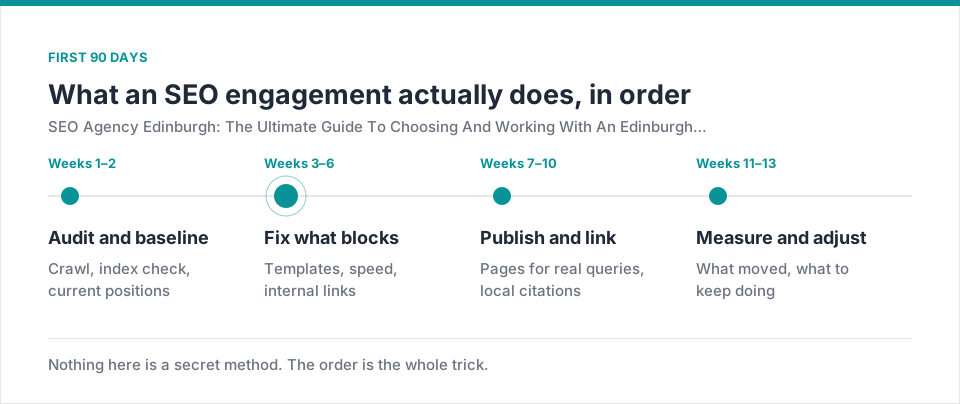
To manage expectations, tie pricing to quantifiable milestones. For example, define targets like proximity visibility in GBP, LP health metrics, and CLP depth growth, with regular dashboards showing district-level performance. CORA Trails ensures every district modifier has a documented rationale, while Translation Provenance keeps terminology recognisable as updates occur, supporting regulator-ready reporting throughout the journey.
Onboarding, scoping and how to start
To begin, request a starter audit through the Edinburgh Services hub and prepare a concise brief for discovery. A typical scoping call will cover district priorities, existing GBP maturity, content gaps, and budget constraints. Ask for a phased roadmap with a 90-day milestone that delivers a live district spine, a shared measurement layer, and governance artefacts. The Edinburgh framework we advocate uses CORA Trails and Translation Provenance as core elements, ensuring every decision is traceable and aligned with local terminology.
- Prepare your inputs for discovery: Write down your district priorities, target districts, and KPIs linked to revenue or inquiries.
- Request a starter audit: A detailed health check of LPs, CLPs, GBP and core technical SEO across Edinburgh districts.
- Clarify success metrics and timeframes: Agree on near-term and longer-term targets to shape the pricing model.
For ready-to-use templates, dashboards and governance artefacts that support a district-aware Edinburgh programme, visit the Edinburgh Services hub on edinburghseo.org and book a scoping discussion through the Contact Page. A well-structured pricing approach paired with CORA Trails and Translation Provenance will offer regulator-ready provenance as you scale across Edinburgh’s districts.
Future Trends in SEO and PPC for London
London brands operate in a high-density, proximity-driven search environment where governance, provenance and district-aware strategies are becoming table stakes. This forward-looking section outlines the trends anticipated to shape SEO and PPC in the capital, with a focus on maintaining authentic locality signals, regulator-ready provenance, and a unified measurement approach that binds Local Pages (LPs), Canonical Local Pages (CLPs), and Google Business Profile (GBP) assets into a single operating framework. CORA Trails (locale rationales) and Translation Provenance (recognisable London terminology) remain the backbone for credible, auditable growth as districts evolve across boroughs.
Key themes to watch include AI-enabled discovery that accelerates ideation without compromising accuracy, the ascendancy of visual and video discovery as primary engagement channels, and a renewed emphasis on proximity signals through GBP and LPs. London campaigns will increasingly rely on a single data backbone that harmonises SEO, GBP and PPC metrics to deliver regulator-ready attribution and clear ROI signals for stakeholders.
1) AI-enabled discovery with guardrails
Generative AI will speed up content ideation, meta-description drafting and schema generation, but publication will require human validation anchored to CORA Trails. AI outputs must be checked against locale rationales and translated into recognisable London terminology via Translation Provenance. The aim is to reap speed without sacrificing accuracy or regulatory compliance. A formal approval workflow should sit alongside AI tools, ensuring all district modifiers are traceable in governance artefacts.
2) Visual search and video discovery
Visual content and short-form video are increasingly influential in discovery, particularly for districts with iconic landmarks, parks and events. Optimise images with district-relevant alt text, structured data that captures place context, and video transcripts that reference proximity signals. A district spine should harmonise visual assets with LPs, CLPs and GBP posts to create a cohesive proximity narrative across surfaces.
3) Proximity and district spine discipline
Proximity signals remain a dominant factor in London searches. GBP updates, district-aware posts and LPs that reflect real-world places enable near-me queries to surface first. A disciplined district spine ties proofs such as landmarks, transport nodes and partner venues to service pages, while Translation Provenance keeps terminology recognisable across updates. CORA Trails documents why each district modifier exists, ensuring consistency and auditability as new districts are added.
4) Cross-channel measurement maturity
A single measurement framework that merges LP, CLP, GBP and PPC data is essential for holistic decision-making. London campaigns should deploy a governed data backbone that supports attribution across channels, with CORA Trails and Translation Provenance providing the provenance needed for audits and regulator scrutiny. Dashboards should present district-level ROI, proximity indicators and cross-channel effects in a unified view.
Practical steps to realise this future include implementing a district spine that anchors LPs and CLPs to GBP assets, establishing a shared data layer, and building governance artefacts that external parties can replay. Regular updates to CORA Trails and Translation Provenance ensure the London language remains familiar as surfaces scale, supporting regulator-ready provenance across boroughs from Westminster to Canary Wharf and beyond.
5) Privacy, consent and responsible data practices
As data collection and personalised experiences proliferate, privacy-by-design remains non-negotiable. London programmes should include clear AI involvement disclosures, robust consent management, and governance logs that demonstrate how data is used to drive locality-aware experiences. Public disclosures build trust and align with platform policies and regional privacy regulations, reinforcing the credibility of locality signals across LPs, CLPs and GBP assets. External references to best practices can guide implementation, such as canonicalisation and data governance resources from leading authorities.
For teams looking to accelerate an ethical, future-ready London framework, start with governance artefacts, dashboards and district templates available via the London Services hub. To tailor the roadmap to your portfolio, book a scoping discussion through the Contact Page and align the plan with your ROI targets and compliance requirements. The aim is to build a sustainable, regulator-ready growth engine that scales across districts while protecting user trust.
Pricing, Budgets And Setting Expectations For Edinburgh SEO Campaigns
In Edinburgh, budget planning for an SEO programme should be driven by governance, provable locality signals and regulator-ready provenance. At edinburghseo.org we emphasise a district-aware approach that binds Local Pages (LPs), Canonical Local Pages (CLPs) and Google Business Profile (GBP) assets into a single, auditable spine. By locking CORA Trails (locale rationales) and Translation Provenance (recognisable Edinburgh terminology) into every pricing decision, you can forecast value, justify spend and scale confidently across Edinburgh’s districts.
Effective pricing for Edinburgh campaigns rests on transparent models that align costs with outcomes. The goal is to enable governance-ready reporting, auditable provenance and predictable budgeting while preserving locality integrity as you expand across Old Town, New Town, Leith and other districts. Below are practical pricing models and the considerations that help you choose the right fit for your business context.
Pricing models you should expect
- Monthly retained services: A stable, ongoing fee covering technical SEO, LPs, CLPs, GBP management, content and reporting. This model suits Edinburgh businesses seeking durable, scalable growth with regular governance artefacts attached to milestones.
- Project-based engagements: Fixed-price work for defined scopes such as a district spine build, full technical audit, or quarterly calendar refresh. This is ideal for pilots or clear, time-bound objectives in Edinburgh districts.
- Hybrid arrangements: A base monthly retainer plus fixed-price project components. This balance offers predictable costs with the flexibility to pursue district-specific initiatives as ROI signals emerge.
- Value- or outcomes-based pricing: Payments tied to clearly defined metrics such as visibility, traffic, inquiries or revenue. In Edinburgh, these models work best with governance artefacts that verify causal links and provide auditable provenance.
When selecting a pricing model for Edinburgh, weigh the predictability of outcomes against the flexibility required by district expansion. A governance-forward partner will attach CORA Trails to every district modifier and preserve Translation Provenance as content evolves, ensuring that pricing remains traceable and justifiable for regulators and stakeholders alike.
Typical Edinburgh budget bands
Budgets vary by district reach, sector complexity and business size. The following bands provide a practical starting framework, with the understanding that exact figures should be tailored to your context and goals:
- Small, local Edinburgh businesses: around £500–£1,500 per month for core Local Pages and GBP uplift in central districts.
- Growing SMEs with multi-district needs: £1,500–£3,500 per month to cover LPs, CLPs, GBP, content and link-building across several districts.
- Mid-market portfolios or multi-client setups: £3,500–£7,000 per month for a robust district spine, governance artefacts and cross-district reporting.
- Larger portfolios or national brands prioritising Edinburgh: £7,000–£15,000+ per month for a comprehensive, district-spanning programme with extensive analytics and cross-channel integration.
Remember, the aim is not to maximise spend but to maximise value. The most effective Edinburgh programmes connect every budget line to planned outcomes, with CORA Trails and Translation Provenance providing traceable rationale as content scales across districts.
Onboarding costs and early value
Onboarding typically includes a starter audit, stakeholder alignment, and a live district spine build. Many practitioners bundle the starter audit within the initial engagement to reduce friction and demonstrate early value. Expect a defined onboarding plan that includes governance artefacts, a shared glossary of district proofs and a transparent data dictionary that links LPs, CLPs and GBP assets to locality proofs.
To accelerate onboarding, request a scoping call via the Edinburgh Contact Page and ask for a starter audit through the Edinburgh Services hub. A credible plan will present a 90-day milestone with a live district spine, a shared measurement layer and governance artefacts attached to every district modifier. CORA Trails and Translation Provenance should be visible in the onboarding artefacts, ensuring you start with regulator-ready provenance from day one.
Measuring ROI and setting expectations
Edinburgh campaigns typically follow a staged ROI trajectory. Early wins usually appear within 60–90 days as technical issues are resolved, GBP listings clarified, and district proofs mature. Medium-term impact, such as improved district keyword rankings and increased local traffic, tends to emerge within 3–6 months. Meaningful revenue improvements often become evident in the 6–12 month window as the district spine deepens and cross-district authority grows.
Link pricing to tangible milestones. For example, set targets for proximity visibility in GBP, LP health metrics and CLP depth growth, with dashboards showing district-level performance. CORA Trails provides the locale rationale behind each district modifier, while Translation Provenance ensures Edinburgh terminology remains recognisable as content updates roll out, supporting regulator-ready reporting throughout the journey.
When evaluating proposals, compare not only price but the total value delivered. A credible Edinburgh partner will present a unified district spine that binds LPs, CLPs and GBP assets, a single data backbone for cross-channel attribution, CORA Trails for locale rationale and Translation Provenance to maintain terminology consistency. Onboarding plans should include a 90-day milestone with early wins and a clear handover pathway to your internal teams. For practical templates and governance artefacts that accelerate a district aware Edinburgh programme, visit the Edinburgh Services hub and book a scoping discussion via the Contact Page to tailor the framework to your portfolio.
To explore ready-to-use dashboards and governance artefacts, see the Edinburgh Services hub on edinburghseo.org and arrange a discovery call through the Contact Page. The aim is to secure a pricing and governance framework that aligns with your ROI targets while providing regulator-ready provenance as your district footprint expands.
Want the numbers behind this? The analytics guide shows how organic traffic and the queries GA4 hides are rebuilt in Semalt.
Pricing, Budgets, And Setting Expectations For Edinburgh SEO Campaigns
A disciplined budgeting framework underpins durable, district-aware growth for Edinburgh businesses. At edinburghseo.org we emphasise governance-led pricing that ties CORA Trails (locale rationales) and Translation Provenance (recognisable Edinburgh terminology) to every financial decision. The objective is to create regulator-ready provenance while delivering measurable improvements in local visibility, traffic and revenue across Local Pages, Canonical Local Pages and Google Business Profile assets.
Pricing in Edinburgh should reflect both the breadth of district reach and the complexity of localisation. A well-structured programme combines a transparent pricing model with a clear pathway to early wins and long-term value. This section outlines practical models, typical Edinburgh budget bands, onboarding expectations, and how to evaluate proposals to ensure you get regulator-ready governance alongside tangible business outcomes.
Pricing models you should expect
- Monthly retained services: A steady, predictable fee that covers ongoing technical SEO, Local Pages, Canonical Local Pages, GBP management, content and reporting. This model suits Edinburgh businesses seeking durable, scalable growth with robust governance artefacts attached to milestones.
- Project-based engagements: Fixed-price work for well-defined scopes such as a district spine build, a full technical audit, or a quarterly content calendar refresh. Ideal for pilots, launch phases in core districts, or targeted optimisation sprints in Edinburgh.
- Hybrid arrangements: A base monthly retainer combined with fixed-price project components. This approach balances predictable costs with the flexibility to pursue district-specific initiatives as ROI signals emerge.
- Value- or outcomes-based pricing: Payments tied to clearly defined metrics such as proximity visibility, LP health, GBP engagement and qualified conversions. In Edinburgh, governance artefacts attached to CORA Trails ensure every outcome is traceable and justifiable.
Each model carries trade-offs. Monthly retainers offer stability and ongoing optimisation; project-based pricing gives clarity for defined milestones; hybrids provide balance; value-based pricing emphasises outcomes. The Edinburgh framework emphasises auditable provenance at every step so stakeholders can replay decisions during audits, and regulators can verify alignment with locality proofs as your district footprint expands.
Typical Edinburgh budget bands
Budgets depend on district reach, sector complexity and business size. The following bands provide a practical starting framework, with the understanding that exact figures should be customised to your context and goals:
- Small, local Edinburgh businesses: around £500–£1,500 per month for core Local Pages and GBP uplift in central districts.
- Growing SMEs with multi-district needs: £1,500–£3,500 per month to cover LPs, CLPs, GBP, content and link-building across several districts.
- Mid-market portfolios or multi-client setups: £3,500–£7,000 per month for a robust district spine, governance artefacts and cross-district reporting.
- Larger portfolios or national brands prioritising Edinburgh: £7,000–£15,000+ per month for a comprehensive, district-spanning programme with extensive analytics and cross-channel integration.
Remember, the aim is value, not simply spend. A credible Edinburgh programme connects every budget line to an outcome, and CORA Trails with Translation Provenance ensures locale rationales and terminology remain transparent as you scale across Old Town, New Town, Leith and beyond. This governance-forward approach helps protect ROI against rapid market shifts and algorithm changes while maintaining authentic locality signals.
Onboarding costs and early value
Onboarding typically includes a starter audit, stakeholder alignment, and the live activation of a district spine. Many practitioners bundle the starter audit within the initial engagement to demonstrate early value. Expect a defined onboarding plan that includes governance artefacts, a shared glossary of district proofs and a data dictionary that links LPs, CLPs and GBP assets to locality proofs.
To accelerate onboarding, request a scoping discussion via the Edinburgh Contact Page and ask for a starter audit through the Edinburgh Services hub. A credible plan will present a 90-day milestone with a live district spine, a shared measurement layer and governance artefacts attached to every district modifier. CORA Trails and Translation Provenance should be visible from day one to ensure regulator-ready provenance as you scale.
Measuring ROI and setting expectations
ROI in Edinburgh campaigns typically follows a staged trajectory. Early wins often appear within 60–90 days as technical issues are resolved, GBP listings are clarified, and district proofs begin to mature. Medium-term impact, such as improved district keyword rankings and increased local traffic, tends to emerge within 3–6 months. Meaningful revenue improvements commonly surface in the 6–12 month window as the district spine deepens and cross-district authoritativeness solidifies.
When planning pricing, tie milestones to quantifiable targets. For example, set objectives for proximity visibility in GBP, LP health scores and CLP depth growth, with dashboards showing district-level performance. CORA Trails provides the locale rationale behind each district modifier, while Translation Provenance ensures Edinburgh terminology remains recognisable as content updates roll out, supporting regulator-ready reporting throughout the journey.
For practical templates, dashboards and governance artefacts that accelerate a district-aware Edinburgh programme, visit the Edinburgh Services hub on edinburghseo.org and book a scoping discussion via the Contact Page to tailor the framework to your portfolio. A well-structured pricing and governance approach enables predictable budgeting, regulator-ready provenance and scalable growth across Edinburgh’s districts.
Link building and ethical outreach in Edinburgh SEO
Ethical, contextually relevant link-building remains a cornerstone of durable Edinburgh SEO. In Edinburgh's distinctive districts—from Old Town to Leith—local signals strengthen authority when links reflect real-world proximity and community relevance. At edinburghseo.org we emphasise governance-first outreach that attaches CORA Trails for locale rationales and Translation Provenance to preserve recognisable Edinburgh terminology as your network grows. This part explains how to build high-quality Edinburgh links without risking penalties, while ensuring every partnership contributes to district proofs and auditable provenance.
Quality link-building in Edinburgh should prioritise relevance, specificity and locality. A link from a well-regarded local publisher, a university partner, a cultural organisation or a district business association carries more weight than generic, non-local placements. The CORA Trails framework helps you justify why a given district modifier warrants a link, while Translation Provenance ensures terminology remains recognisable across updates. This alignment creates a coherent proximity narrative that search engines recognise as legitimate authority rather than opportunistic link-building.
High-value, Edinburgh-relevant link targets
Identify targets that are inherently connected to Edinburgh life and its districts. Examples include local universities, city councils and cultural centres, prominent Edinburgh events, garden and heritage sites, and industry associations with Edinburgh membership. Each target should offer editorial value to your district-spine pages and provide a clear, contextual reason for linking. By tying links to district proofs — such as proximity to landmarks or transport routes — you enhance proximity signals while maintaining compliance and editorial integrity.
- Local educational institutions and research centres with depth in Edinburgh districts.
- City-affiliated directories, chamber of commerce pages and district business networks.
- Region-specific media outlets that cover Old Town, New Town, Leith and nearby areas.
- Neighbourhood partner pages and community organisations with verifiable local activity.
Outreach best practices: ethical, transparent and district-aware
Outreach in Edinburgh should be targeted, respectful and aligned with local interests. Start with a data-driven prospect list built around district proofs, events calendars and partnership opportunities. Attach CORA Trails to each outreach plan to explain why the district modifier is relevant. Use Translation Provenance to maintain recognisable Edinburgh terminology when drafting outreach messages, ensuring your communications feel authentic to local audiences.
- Prospect segmentation by district: Prioritise Old Town, New Town, Leith and other strategic districts with district-specific rationale.
- Personalised outreach with local relevance: Reference local landmarks, routes, and community initiatives to demonstrate genuine interest.
- Editorial alignment and disclosure: Clearly state editorial intent and ensure transparency about any compensation or reciprocal linking arrangements.
- Content-worthiness criteria: Ensure linked content provides value, is well-written, and adds authoritative context to the reader.
Governance and provenance in link activity
Governance artefacts should capture every link decision. Record locale rationales in CORA Trails and preserve Edinburgh terminology with Translation Provenance as content evolves. Maintain a data dictionary that maps each link to its district proof and service area. This approach enables auditability, supports regulator-ready reporting and allows leadership to replay linking decisions if needed. A shared dashboard that tracks district-specific backlinks and their impact on LPs, CLPs and GBP assets helps you prove ROI and maintain trust with Edinburgh audiences.
- Link provenance: Attach CORA Trails to explain why a link was pursued and how it supports district proofs.
- Terminology stability: Use Translation Provenance to keep Edinburgh language consistent across updates.
- Backlink governance: Maintain a changelog of outreach activities, approvals and disavow actions when necessary.
Risk management and penalties avoidance
Edinburgh-focused link-building must avoid manipulative tactics. Never buy links or participate in schemes that violate search engine guidelines. Instead, emphasise editorial merit, community relevance and editorial partnership. Regularly audit your backlink profile for spam, low-quality domains and tied referrals that do not reflect real-world proximity. If a link is questionable, use a formal disavow process and document the rationale in governance artefacts so audits can trace decisions and outcomes.
A practical outreach workflow you can implement
Adopt a disciplined workflow that integrates CORA Trails and Translation Provenance at every stage. Begin with district-focused prospecting, followed by outreach with personalised, value-driven content, then secure editorial placements. After publication, attach a provenance note to the page and update your dashboards to reflect link activity by district. This workflow improves accountability and makes it easy to demonstrate regulator-ready provenance as your Edinburgh district footprint expands.
- District prospecting and validation: Build a district-driven list and verify relevance and editorial quality.
- Align with local topics, events and institutions to increase acceptance.
- Editorial approval and disclosure: Obtain sign-off on content and disclosure statements to maintain transparency.
- Publication and provenance: Add a CORA Trails entry and Translation Provenance tag to the published page.
- Ongoing monitoring and governance: Track backlink performance and schedule quarterly governance reviews.
For practical templates, dashboards and onboarding playbooks that support a district-aware Edinburgh programme, visit the Edinburgh Services hub on edinburghseo.org and book a scoping discussion through the Contact Page to tailor the framework to your portfolio. The aim is to sustain regulator-ready provenance while building credible, local authority through sustainable link-building across Local Pages, Canonical Local Pages and Google Business Profile assets.
As you scale Edinburgh link-building, focus on quality over quantity. A handful of high-authority, highly relevant links can outperform numerous generic placements. Maintain discipline with CORA Trails and Translation Provenance, and ensure every link activity reinforces the city’s authentic locality narrative. When in doubt, consult with your Edinburgh SEO partner to keep the programme regulator-ready and aligned with district proofs.
To begin, consider a starter outreach plan that targets core Edinburgh districts first and gradually expands to surrounding catchments. Leverage the Edinburgh Services hub for governance artefacts, dashboards and templates, and schedule a discovery call via the Contact Page to tailor the strategy to your portfolio. Embedding CORA Trails and Translation Provenance from day one will help you maintain authentic locality signals, regulator-ready provenance and scalable growth across Local Pages, Canonical Local Pages and GBP assets.
If you would like ongoing guidance, revisit our governance templates and dashboards within edinburghseo.org’s services pages and stay connected through regular scoping sessions. The goal is a repeatable, ethics-forward link-building framework that supports durable Edinburgh authority while upholding the highest standards of transparency and accountability.
Take the next step today by booking a discovery discussion to align your Edinburgh link-building with CORA Trails and Translation Provenance, ensuring every connection enhances locality relevance and remains auditable for regulators and stakeholders alike.