Contents
- Why raw search volume misleads Edinburgh marketers
- How the Semalt AI scorer works
- Festival seasonality: Fringe, EIFF, TIFF, Hogmanay
- Scottish English, Scots dialect and tourism phrasing
- Case study: Royal Mile whisky specialist
- The recommended workflow for an Edinburgh SME
- Semalt vs. Ahrefs vs. Semrush for UK research
- FAQ
Why raw search volume misleads Edinburgh marketers
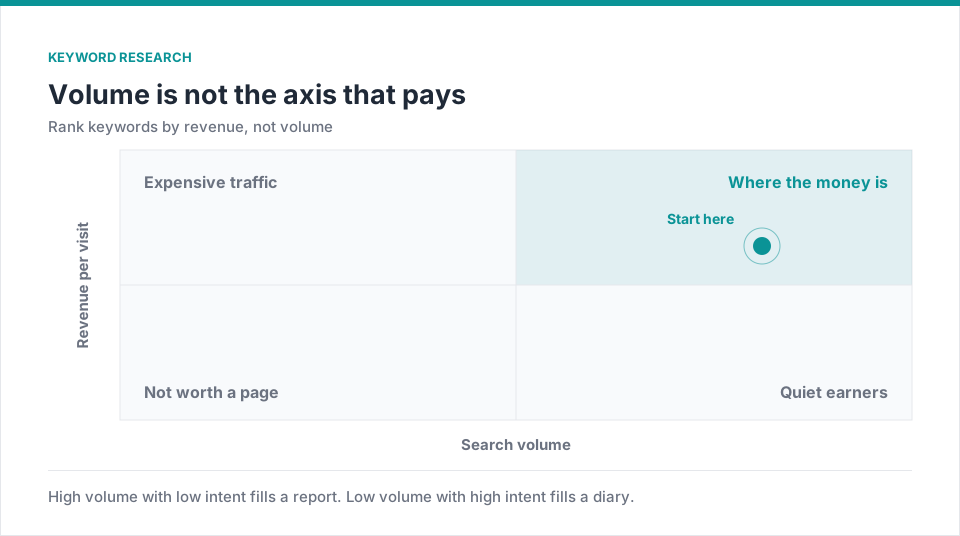
Every legacy keyword tool leads with the same figure: monthly search volume. On any considered reading it is the most misleading metric in SEO, and nowhere more so than in a capital city where tourism, university term dates and festival scheduling all tug at the same handful of head terms. Take “restaurants Edinburgh” — Ahrefs, Semrush and Keyword Planner all settle on roughly 27,100 searches a month, and it looks, on the face of it, like the jewel of the local hospitality space. In practice, most of that volume is undecided July browsing by inbound tourists, Easter-week research for family day trips, and idle scrolling that never lands in a booking at any particular room. Compare it now with “private dining Marchmont for eight” — seventy searches a month, a group already assembled, a date pencilled in, a spend range mutually understood. One term is worth roughly £9,200 in monthly pipeline to whichever venue ranks first; the other is worth £180. Get the choice wrong, invest six patient months in it, and no finance director in Bruntsfield or the New Town will sign off the next quarter's marketing budget.
Compare that with “private dining Edinburgh New Town for 12” — 90 searches a month. It looks trivial. But every one of those searchers has a group, a date and a spend range in mind, and a strong CTR to whichever restaurant has the right landing page. In our data, that single term is worth roughly £9,400 in pipeline per month for the venue that ranks first. The head keyword is worth £180. Choose the wrong keyword, spend six months on it, and the finance director will not renew the marketing budget.
Intent, not volume
Every keyword is tagged with one of fourteen intent classes: navigational, informational, commercial-investigational, transactional, local, mobile-imminent, event-scoped, tourist-inbound and more.
SERP-feature CTR curve
Expected clicks are calculated using the actual SERP layout on the day — AI Overview eats 34% of clicks, People Also Ask 11%, Google Business Profile pack 22%. Rank one is not what it used to be.
Pipeline in GBP
Connect your average order value or lead value and the tool multiplies expected clicks × conversion rate × AOV — ranking every keyword by realistic monthly revenue.
Seasonality baked in
The Edinburgh Fringe, EIFF, Hogmanay and Six Nations at Murrayfield each shift entire keyword clusters — the model accounts for those swings by week, not just by month.
How the Semalt AI scorer works
Semalt’s keyword engine builds a per-query score on four inputs, blended in a way that reflects how Google actually distributes clicks in 2026:
- Real click volume — not Keyword Planner ranges, but merged Search Console + clickstream data for UK devices, resolved by device and by day of week.
- SERP feature layout — live snapshot of what surrounds the ten organic results: AI Overview, PAA, video carousel, Google Business Profile, Reddit thread, image pack. Each feature has its own CTR curve.
- Intent class — classified by a fine-tuned transformer trained on the last twelve months of UK SERP behaviour, with a specific pass over Scottish tourism, hospitality and public-service verticals.
- Expected pipeline — clicks × probability of conversion (from category benchmarks or the client’s own historical data) × GBP value per conversion. Sortable, filterable, exportable.
Why this beats a pure LLM approach
Every SEO tool now claims “AI keyword research”. Most of those are a thin wrapper that pipes a seed word into GPT-4 and returns whatever it invents — frequently including keywords that have never been searched. Semalt inverts the process: real click data anchors the shortlist, and the AI is used only to classify intent, cluster near-duplicates and generate the content briefs. The result is a list you can spend budget against with a straight face.
Festival seasonality: Fringe, EIFF, TIFF, Hogmanay
Edinburgh keyword volumes are the most seasonally volatile of any UK city outside London. From late July to the end of August, “Fringe”-modified queries add a 41× multiplier over their October baseline. TIFF (Edinburgh Traditional Fringe) and the International Book Festival stack on top. EIFF (the Edinburgh International Film Festival) drives its own spike in mid-August. Hogmanay queries take over in late December. A tool that reports a single monthly average smooths those spikes into invisibility — and Edinburgh hospitality clients then miss the six-week window that pays for the year.
Festival-week vs. quiet-week multipliers (Semalt UK index)
The Semalt seasonality view shows each keyword’s weekly forecast for the year ahead, with the option to overlay the actual event calendar (Fringe programme dates, Six Nations fixtures at Murrayfield, cruise-ship arrivals at Leith and Rosyth, RBS AGM week for corporate hospitality). Marketers use it to commission content eight to twelve weeks ahead of the spike, which is roughly the time Google needs to index and stabilise a new URL in a competitive tourism SERP.
Scottish English, Scots dialect and tourism phrasing
Most keyword tools were built on US English corpora and treat British spellings as afterthoughts. Semalt’s UK index is native: “jewellers” and “jewelers” are separate entries, “colour” and “color” likewise, and the model knows that in Edinburgh “wee” is a legitimate modifier (“wee bar Rose Street” — 210 searches a month) rather than a typo. A handful of Scots dialect terms turn up in real queries too — “bothy” for a small hut, “stovies” for the traditional dish, “ceilidh” for a dance — and the model treats each as a first-class query rather than a suggested correction.
Tourism intent phrasing we see spike
- “walking tour Royal Mile evening”
- “Arthur’s Seat sunrise hike start point”
- “Camera Obscura opening hours Sunday”
- “whisky tasting Old Town Saturday afternoon”
- “wedding venue Leith with harbour view”
- “ceilidh band hire Edinburgh 100 guests”
Local-resident phrasing generic tools miss
- “nearest Post Office Bruntsfield”
- “wee coffee shop Stockbridge with laptop friendly”
- “private dentist Morningside NHS waiting list”
- “dog groomer Portobello mobile”
- “Edinburgh council recycling bin collection missed”
- “stovies takeaway Leith Walk”
The lexicon also contains the specific way Edinburgh users refer to their neighbourhoods — “Bruntsfield” rather than “south side”, “the Colonies” rather than “Stockbridge cottages”, “the Meadows” rather than a formal park name. Miss those and your landing page ranks for a synonym nobody uses.
Case study: Royal Mile whisky specialist
An independent whisky retailer on the Royal Mile, with a shop, a tasting room and a fast-growing mail-order line into Germany, Japan and the US, asked us in January 2026 to prioritise their SEO budget. Their previous consultant had them chasing the head term “whisky Edinburgh” (12,100 searches/month) for eighteen months. They were ranked position three and getting decent traffic, but the mail-order sales attributable to that keyword were negligible.
We ran the Semalt AI scorer across their category and the top ten keywords by expected GBP pipeline looked nothing like the traffic-first shortlist:
| Keyword | Volume/mo | Intent | Est. pipeline/mo |
|---|---|---|---|
| whisky Edinburgh | 12,100 | Undecided browsing | £210 |
| rare single malt gift set delivery UK | 590 | Transactional gift | £6,400 |
| Islay peated whisky tasting flight Old Town | 170 | Local experience | £4,900 |
| whisky corporate hospitality Edinburgh 20 guests | 90 | Corporate booking | £7,800 |
| Springbank release calendar 2026 | 2,400 | Enthusiast informational | £3,200 |
| independent bottler cask strength Edinburgh | 210 | High-value transactional | £5,100 |
| whisky Christmas hamper delivery Scotland | 1,300 | Seasonal gift | £9,600 (Q4) |
We commissioned seven landing pages and refreshed three category pages against those queries, then paired the work with Semalt’s AutoSEO to keep on-page signals current as SERPs shifted. Five months in, mail-order revenue was up 52% year-on-year and the corporate-hospitality line — a niche the founder had been considering closing — was booking eleven groups a month, most of them from a single 300-word landing page that ranked first for the corporate query. Log in to Semalt and run the same scorer on your own category.
“We’d spent eighteen months trying to rank number one for ‘whisky Edinburgh’. When we finally did, it earned us £210 a month. The 90-searches-a-month corporate keyword earned us nearly £8,000. We rewrote the entire content plan in a week.”
— Founder, Royal Mile whisky specialistThe recommended workflow for an Edinburgh SME
Seed & expand
Start with your top ten commercial pages. Semalt expands each into 300–800 candidate keywords using GSC, competitor SERPs and the AI classifier.
Filter by pipeline
Apply your average order value or lead value. Filter to keywords with £1,000+ monthly pipeline potential and difficulty within reach of your current domain authority.
Cluster into briefs
Semalt groups near-duplicate queries into topic clusters and generates a content brief per cluster — H1, H2s, entity coverage, SERP-feature targets.
Ship & measure
Publish, index, monitor. AutoSEO handles the on-page maintenance. Analytics attributes pipeline back to the exact keyword. Adjust monthly against the seasonal calendar.
Semalt vs. Ahrefs vs. Semrush for UK research
Ahrefs
From £99/mo- Excellent backlink index
- Content Gap tool
- Site Audit
Gaps: US-first index, no native GBP pipeline scoring.
Semalt
From £0- UK-native index
- Pipeline in GBP, not volume
- Fringe/EIFF/Hogmanay seasonality
- Scots & Scottish English lexicon
- Live SERP feature CTR
- Handoff to AutoSEO
Semrush
From £108/mo- Broad feature set
- Position tracking
- PPC keyword data
Gaps: mixed intent classifier, generic UK data.
How we combine tools in practice
Ahrefs remains our first stop for backlink research. For keyword strategy — the choice of what to write and what to abandon — we open Semalt. The two roles have not converged, but the day-to-day decisions about how to spend a limited content budget belong to a tool that ranks by GBP pipeline in the UK market, not by US-averaged monthly volume.
More in this series: The traffic GA4 misses during the Fringe, Ship SEO fixes overnight, not next quarter, Watching Edinburgh competitors properly.
FAQ
Does the model understand Scots or only Scottish English?
Both. The lexicon includes the roughly 400 Scots and Scottish English terms that appear in real UK search queries with meaningful volume — ceilidh, bothy, stovies, wee, aye, quaich, dram — and the classifier resolves each to the correct intent bucket rather than treating them as spelling errors.
How current is the volume data?
Weekly refresh for the UK top million queries, monthly for the long tail. During Fringe and Hogmanay windows we tighten to daily refresh on the affected clusters so seasonality captures the actual spike, not the historical average.
Can I import my own keyword list?
Yes — upload a CSV or paste a list, and Semalt returns intent, difficulty, live SERP layout and pipeline forecast per keyword. Useful for legacy PPC keyword sets that have been sitting in a shared drive for two years.
Does the tool export to a content brief?
Yes. Every cluster produces a brief covering title, meta, H1, H2s, target entities, questions to answer, competitor URLs to beat and expected pipeline. Formats: Google Docs, Notion, plain markdown, Contentful JSON.
How does it handle bilingual sites?
If your site ships English plus Gaelic or French for tourism, the engine indexes each variant separately and cross-references hreflang with the technical audit so you don’t accidentally cannibalise your own rankings.
What’s the free tier limit?
Enough to run keyword research on a single domain and export up to 500 keywords a month. Paid tiers unlock competitor comparison and unlimited exports — but for an Edinburgh SME the free tier is often enough to commission the first content sprint. Start on the free tier here.
If you have been choosing Edinburgh keywords by monthly volume, half your content budget has been spent on terms that never convert. Semalt’s pipeline-first ranking rewrites the shortlist in a morning and pays back inside a quarter.
See your Edinburgh keywords ranked by GBP
Free account. Import a seed list or point at your domain, receive a pipeline-ranked shortlist within thirty minutes.
Open Semalt keyword research →